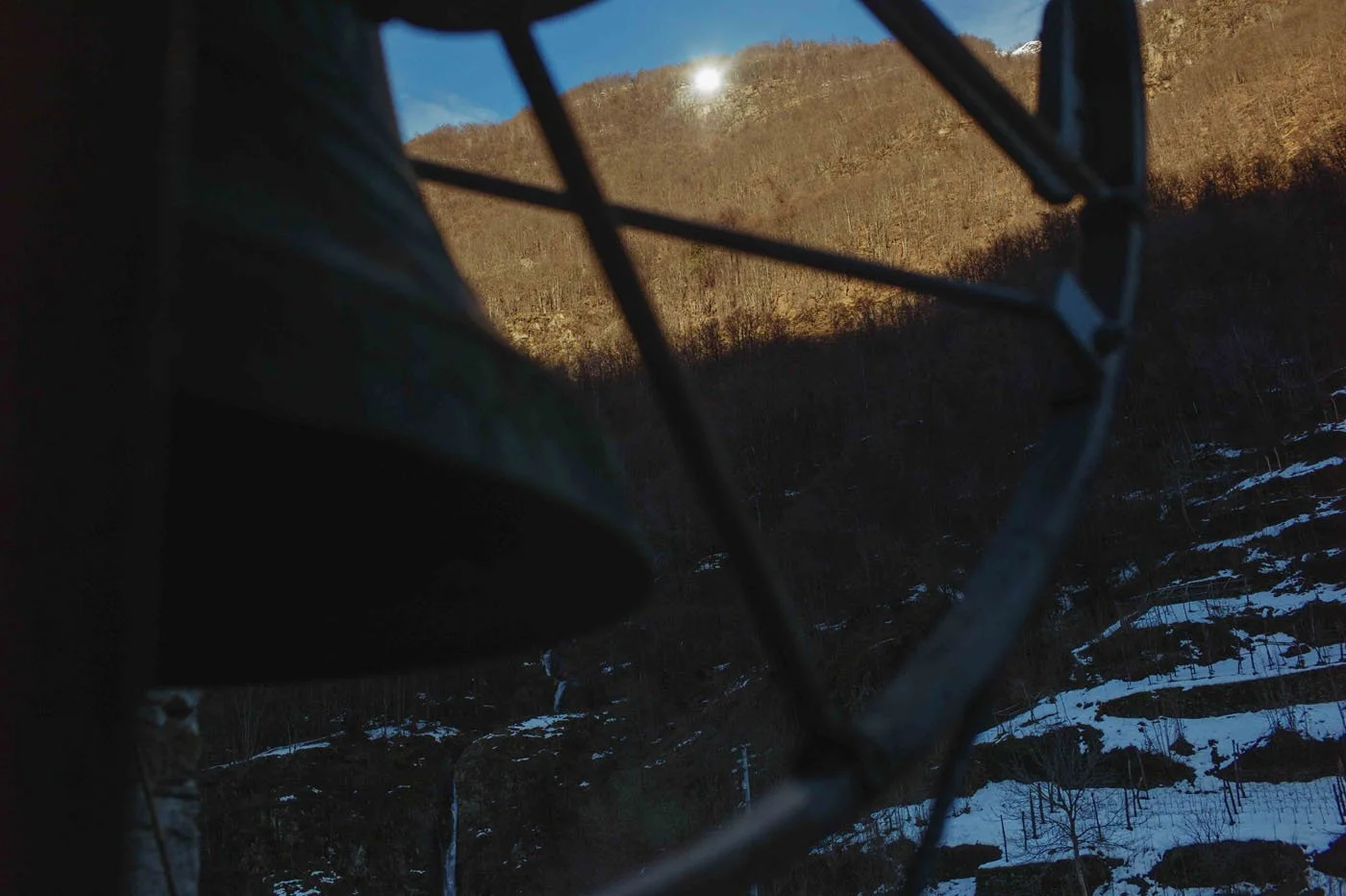
_from_ flit filters

“… details are made available by mapping the data to colors that humans can perceive.”—NASA Jet Propulsion Laboratory News


(zinnias in space, ISS)


It’s a fable, really, it’s a cartoon of itself. It’s a lesson in starvation really. 


It’s a fable where I see myself a child planting zinnias but I am planting the idea of childhood.


It’s a fable for the soon-removal, the ruin of the rooted where seeing anything is like seeing a flower without a world, the zinnias’ perfect gears of orange petals controlled enough to live almost anywhere, removed enough to appear in geometric form. It’s a fable where the orbit betrays girlhood zinnia plots and no one ever pokes a finger one inch in the planet to press the seed fleck into the soft. I read a fable a fairy tale a seed packet label called abandonment called post-earth ideation or airless station or round-tipped zinnia petals fixed in pixels. Autonomous gardening spilled into neural petals’ algorithm-seeing. They spoil themselves with lack of soil. They zero out omission. They are not unlike cell-phone screens or golf greens or gated community crests, orange in green and green in orange and orange in green and people forage in their removal… someone eats up their own cloud-cover and calls it survival. 


It’s a satellite-slick night. This platoon of petals calls itself living being
resuscitation bright.


(keyhole inside the debris resulting from the birth of a new star, Orionis)


The thought of seeing became debris. The cactus flower, the picture frame. The [is seen] a keyhole inside the unseen debris, a wisp of a keyhole really, every hint of sight a wisp against the quicker vanishment. The fire rims were growing, the ragged maps debris-forming, the color-coded evacuation status, the future/past craggy trail the floral comforters to-do lists anything potentially seen potentially cast into flammable reams. The unseen debris included the receptacle for Scotch tape empty of tape… you put your thumb in it and rummage the spin. Inside the fire, the burnt flower, vanished flower, locked in the mind. 


The eyes look backward for a way. The debris inside the keyhole included colliding debris of disappearance and appearance simultaneously. I want to tape the ash together until the tape has no glue and spin in keyhole trace with you+you+you+ 


The place you wandered among the cactus needles and the bulbous purple cactus grapes that vanished in a day.


_________________


Note: Some diction in this series originated in image descriptions on NASA’s various Instagram accounts. 


zinnias:
https://www.instagram.com/nasa/p/CtZxuGjSorR/
keyhole: https://www.instagram.com/p/C59J7n6S5LX/ 

The Hills

One day above Paris
Two big airplanes were fighting
One red the other black
While the sun’s eternal
Plane flashed at the zenith

The one was all my youth
The other the future
This is how furiously
The archangel with shining
Wings fought Lucifer

Calculus to problem
Night to day the way my
Love attacks what I love
The way a hurricane
Roots up trees that cry out

But look everywhere such
Sweetness Paris wakens
Slowly and stretches out
Like a girl shakes her long
Hair and begins her song

Well now where’d my youth go
See the future’s on fire
Listen I’m announcing
The art of prophecy
Is born at last today

Certain people are hills
That rise up in our midst
They can see what’s coming
Better than what’s here clearer
Than what’s already gone

In time’s adornment roads
And seasons go on stay
Don’t stop let serpents hiss
At the south wind in vain
The Psylli and the wave have died

In time’s arrangement if
The machines finally
Learn to think waves of gold
Will break on jeweled shores
Foam be mother again

Eagles are not so high
Flying the human gives
Oceans pleasure vents off
Shade and vertiginous spleen
Till the soul meets its dream

This is the magic time
It’s coming back you wait
Billions of wonders
Still unfabled still
Unimaginable

Deep wells of awareness
Tomorrow we’ll find you out
And who knows what live beings
We’ll lift from the abyss
Along with their universes

Look how the prophets loom
Like blue hills far away
Knowing the exact things
Scientists pretend to
They’ll take us everywhere

To want is to be strong
Let me kiss your forehead
O lithe as a flame you
Suffer all a flame does
All burning all sparkling

In the next age we will
Study our suffering
Not with courage not with
Discipline but knowing
There’s nothing we can do

We’ll find out what’s human
Beyond all we have been
Put both intention and
Strength of will to the test
Without tools or machines

Helpful specters wander
Filtering among us
Since time has caught us up
Nothing ends or begins
See that ring you’re wearing

Time of deserts of crossroads
Time of plazas and hills
I’m here to do some tricks
With a dead talisman
More intricate than life

I’m finally separate
From every natural thing
I can die but I cannot sin
And what no one has touched
I’ve touched it I’ve felt it

And I’ve looked into things
Nobody imagined
I’ve even weighed out life
The unthinkable and
I can die smiling

Often I’ve glided so high so
High goodbye everything
The phantoms the freaks
I can’t admire the boy
Anymore who faked fear

Youth goodbye time’s jasmine
I breathed in your fresh smell
In Rome on flowering carts
Laden with masks garlands
And bells for Carnaval

Goodbye youth white Christmas
When our life was one star
I stared at reflected
In the Mediterranean
Less meteor than pearl

Downy as archangels’
Nests or garlands of clouds
Buffed brighter than halos
Splendors emanations
Single sweet harmonics

I stop to watch a snake
Meandering over
The blazing lawn it’s me
I am the flute I play
Also the whip to flay

A time will come for sorrow
A time too for kindness
Youth goodbye now’s the time
To know the future and
Not die from the knowledge

It’s time for burning grace
By sheer will seven years’
Astonishing trials
Human become divine
More pure more live more wise

Seeking out other worlds
The soul will crinkle up
Like flowers give way to
Lush fruits we’ll see ripen
On hillsides in sunlight

I’m talking about real
Life as only I can
My songs falling as seeds
Be quiet you singers
Don’t mix your chaff with wheat

A vessel came to harbor
A big ship flying flags
There was no one aboard
Except a beautiful vermilion
Woman lying murdered

Once when I asked for alms
All I got was this flame
That burned up to my lips
A torch nothing could snuff
I couldn’t say thank you

Well where are you my friend
Sunk so far in yourself
You left a chasm
So I threw myself in
To the colorless depths

And I can hear my steps
Return down paths no one
Has walked I hear my steps
At all hours there they go
And back now hurrying now slow

Winter you hold the razor
It’s snowing I’m a wreck
I’ve crossed the bright sky life
Is music there the ground
Is too white for my eyes

These wonders I’m announcing
Get used to them like me
To the kindness that rules
To the sorrow I bear
And you’ll know what’s to come

Sorrow and kindness form
The beauty that will be
More perfect than any
Proportion it’s snowing
I’m burning I’m trembling

Now I’m at my table
Writing down what I felt
And what I sang up there
A slender swaying tree
Wind pouring through its hair

A top hat sits there on
A table piled with fruit
Dead gloves near an apple
Madame wrings her own neck
Monsieur swallows himself

Dancers whirl on time’s bedrock
I killed the handsome bandleader
Now I’m peeling an orange
For my friends so they can
Taste amazing fireworks

Everyone’s dead the head
Waiter pours out unreal
Champagne a frothing snail
A poet’s cranium
While a rose is singing

The slave grabs a bare blade
It seems like springs like streams
And every time it falls
It guts a universe
New worlds rush from the wound

The driver holds the wheel
And every time the road
Curves he honks the horn and
There edges into view
A universe untouched

And third number the lady goes
Up in an elevator she
Goes up up forever
The light spreads out she stands
Transfigured in its glow

But these are weak secrets
There are far deeper ones
That soon will be unveiled
Tear you to a hundred
Pieces of single mind

But cry cry and again
We’ll cry to the full moon
Or only crescent cry
Cry and we’ll cry again
Much as we laughed in sun

Arms of gold hold our life
Enter the golden secret
All is nothing but quick flame
The flame unfolds the rose
The rose smells exquisite


                          Translated from the French by Sam Lohmann

The Vessel

Guilty debtor of long-lasting thirst,
Wise procurer of wine and water—
Fruit ripens to the music and goats
Dance in circles along your borders.

Of the troubles on your red-black rim
Shrill flutes swear and whistle and rage—
And there’s no one to get a tight grip
And to set those troubles straight.

March 21, 1937


                          Translated from the Russian by Matvei Yankelevich & John High

_________________


Translator’s note: The poems Osip Mandelstam composed during his three-year exile in the southern Russian city of Voronezh, more than ninety in all, are divided into notebooks corresponding to three distinct periods of poetic production, with the three poems in this issue of Harp & Altar belonging to the third notebook. They are some of the last poems Mandelstam wrote during his exile as part of the book-length work he projected under the working title The Voronezh Notebooks, but would not see published in his lifetime. He died about a year and a half after their composition in a transit camp in the far east of the Soviet Union. 

The spring of 1937 was both a hopeful and desperate time for Mandelstam and his wife, Nadezhda. Their period of exile was coming to a close, and their release was not far off. However, their financial situation was terrible, and Nadezhda was often ill, while Mandelstam himself had been through periods of very poor health exacerbated by his nervous condition. He still harbored the hope of publishing a book of his new poems on his return to Moscow, though his submissions to journals and his letters to the Writers Union went mostly unanswered. He wrote sometimes desperate letters to friends (often including the latest poems in manuscript), begging for monetary support or for intervention on his behalf with the higher-ups at the Writers Union, at times hinting that they should bring his situation to the attention of Stalin himself.

The ekphrastic poem of March 21—often referred to as “The Vessel” (Кувшин [kuvshin]), and sometimes published with that title—riffs on the ancient Mediterranean (Mycenaean or Minoan) pottery Mandelstam saw in the antiquities hall of the Voronezh museum, which he and Nadezhda frequently visited. The protagonist of the poem—the krater or wine jug itself—is cast as both suspect and destined for a tragic end. It is a “guilty debtor” to those who drink from it, and “procurer” (i.e. a pimp of sorts) for the meeting (i.e. mixing) of wine and water, a practice common in antiquity. (The Russian word translated here as “procurer”—сводник [svodnik]—suggests the facilitation of sexual encounters or other unsavory or even illegal activities, but is too archaic to be translated as “pimp.”) The scenes of festivity and fecundity painted on the vessel contrast with its troubled fate. The final lines underscore its helplessness: No one will come to its aid, to avert its inevitable cracking, or to save the civilization it represents. Is the vessel a synecdoche for the inevitable demise of Mycenaean civilization (itself a synecdoche for the “Western” civilization Mandelstam would have termed “world culture”), or—also—for the poet’s uncertain future?

—Matvei Yankelevich

Untitled (I'm part of your therapy now)

I’m part of your therapy now says
the pleasant snap of dog’s jaws on a treat.
I read the article, like it on behalf of others, behavioral economists
making crazy plans for us to wave a crazy wand over pain of payment,
how to get around it and step with
two shoes into a glossy brick house with blue shutters—
how quiet it is there, how white the walls. Here, dish towels
dry on the oven-door handle, the dishwasher never used.
The wound is confusing so making sense of it
may not make it hurt less. There are years between
these types of purchases. Remember our trip to Kansas,
how I started talking about how my brain
has been the same for a while and how
you can see that in other people, that
realization, the same brain
all their lives. A lot more people
think or worry about the same-brain
entire-life problem than we can imagine. You’d
think fewer would. And there’s surely
too many people worrying about it
in one sense and not enough in the other of
knowing how a given brain moves through
a world more populated by other people
than any one of us can imagine, and among them
only a few people you really feel open with
like a diamond mine sometimes
or a coal mine at least that can be blasted back open
whenever a vein falls in on whoever’s down there.
Others are like squirrels in human dwellings,
you can only hear them in the roof or walls.
You talk about whether a part of you hurts and how
you feel about your body in the dark, how you
forget and remember things together
and have friends who you talk about other
friends with and not everyone gets used
to it. Our will to be in the world slips
with others and without each other’s elbows
to hold onto or set on the table. I would
land on my lonely ass and everyone in town
would tell the secrets they have,
ear to ear gossip would string its effect
in dark repetition of the push and pull
of air out of and into lungs until the sound becomes
permanently pressed on the brain, the back
of the neck, the shoulders and jaws and knuckles.
The history of ankles, noses, toes, bellies
barking at your heels, all those terrible haircuts,
the furniture you’ve found on the street or made vs.
the furniture you bought
wounded in some carelessness, reminders of
those moments in life whose particulates
dissipate into the atmosphere in parts per million or
lottery ticket winnings, shavings against hope
of a future of regular paychecks dashed daily
in what the news tells us about statistical likelihoods
one demographic in one zip-code number as opposed to others
which we wish affected how people felt, so they’d feel
differently about themselves as opposed to us or
that they saw what we saw
in them that they didn’t, yet knowing
that in us they maybe see something we may not like,
like the sloppy-armed furniture
given from the farthest ends of the family—I can’t believe
I let you convince me to throw it out. I find
the expression “thin-skinned” so strange, how they say
the strong master their emotions, that wilderness of after-images
working on ours. Rational actors, use of society, use to society—
made to manage ourselves and plan a course through the churn
almost out of a want-to-want way of thinking,
never a wish to give ourselves over
as if on some faraway beach.

At a certain point all the jobs
become worth more or less than their pay. What a person is
called to do, despite the warning of a life without
retirement savings or assets or healthcare, starts to feel tight
from the throat down into the chest and up into the ears.
The person most interesting in a therapist’s day,
the kindest customers and customer service agents.
Maybe there’s a difference, maybe there isn’t
between a call to care and a call to organize.
Facts other us; facts are all we have to hold on to
about as good as a mirror on the other side of the room.
Our view of ourselves and others, presuming
we can identify brain patterns and backtrace
through frames of shared experience that at some point
became almost like a still life of fruits, vegetables, glassware,
a loaf of bread. The way houseplants tell us what they need.
The odd angles of the room in the glass, like the world
our folks raised us in and used to understand themselves in:
such as how it feels differently washing hands in the bathroom or kitchen,
the trusted sites and servers. A virus pings the unique
intersections in our lives, another string bumping up personalizing stories about
how we’re coping, what helped carry us through. I used to want
to be a problem to be given attention or to just be different
and interesting in ways that later made me embarrassed,
ashamed or both. Now I try to hide it because it pays better to be similar
or to only be different in ways that read well. But I still
want to be liked and accepted. I am so uncomfortable
with myself that I sometimes go out of my way
to make others feel comfortable with themselves.
I worry that too could be a want-to-want way of thinking
because in people like that you can tell that they’re for you because
they let you know they care in terms of the cost of loss to
the human community. The scrape
of the car keys gently but often around the lock
eventually leaves its mark.

Sound of an ice cooler being stirred, snow shoveled,
the high tone of a fan versus the low tone of a furnace.
Both seasons affecting the degrees of windows open,
closed and a finger wetted in jest held in the air
to ascertain current path of breeze through apartment
which we see traced in the dog hair that rolls like
tumbleweeds on the hardwood floor where
the things we spill get sticky and the blood we spill
seems so intimate. Mostly from fingers and feet at least.
The nails due for a trim scrape through the wax
and shellac. Vomit mostly from the dog
who will rise and huff when he hears,
before I do, unless asleep, the tone of the engine of
the car you’re still paying off and you let me drive.
I have kept the old spark plugs in a door as part of
one of those symbolic messes that remind me of things I’ve done
that I’m proud of. To have known of the results of
the DNA genealogy before mom said what they were.
To refrain from ever telling you about the asymmetry
of my face for fear that you will never be able
to un-see it. Commit self to well-being. I mistake
the sound of your key in the lock when it’s just a pop in the refrigerator
or the next door neighbors or tags on other dogs’ collars.

Famous People Make Mistakes

I imagined the flower would be entertained
by my mistakes,
then ashamed.
I did not know a mistake
is only a reaction twisted up in sympathies.
The event is a flower.
A flower is a wolf.
Famous people make mistakes.
A flower is a wild dark hole.
The reaction to the event is the human struggle
to interpret a flower.
A flower gestures
the form of the event.
You know the style of a flower by its speed.
It was the accident they say love is.

3/20/21

on the first anniversary of the New York lockdown

history's toe is no marvel
no orchestra darkens its helmet
its hissing city
hisses too

discover this: this
far from sound color
retreats, a poached touch may
throb in dreams and nothing violate
the haywire exterior

well, Mary, better let it,
and elongate like a mushroom
in the rented patch
your own life's dark
for the old speeds still appall
no vicious crystals go
no feeding only talking at the trough

remember kissing
remember just sitting there

now I crack eggs, gas a roach, read, steam
like a horse in slush

11/20/24

I like the milky quality of light in November
I like to think I'm the Roy Orbison of average American gay men
Neo-Nazis are marching in Columbus
I express a second coffee through its shining tin pod and return to the poem

Who does the work gets the work done
Who flees it suffers and is antic and/or morose
Orbison triumphs when my heart heaves to Crying
"I was all right, for a while"
"I could smile, for a while"

Can we see the Sienese painting show
In which long-scattered segments of admired altar pieces
Have been reunited for the first time on our continent
Tambors and timbrels of luscious color
Bent to grave themes

I want to but I can't on Monday
How are the cantons of Switzerland faring
Glacial shrinkage and "rightward drift"?
Does Canton neighbor Columbus?
Is that where he thought he was going?

45 pro-democracy activists have been sentenced to jail in Hong Kong
In Guangzhou a Spaniard in soft thin pants
Sliced me a tomato twelve years ago
In a dark kitchen
Whose window opened onto a thundering ten lane highway
As erotic as it sounds

Continuance

You have worn the form of of

Fingers clasped in a rough weave


Shadow rabbit on the taupe wall

A known pattern on the blue sheets


Strummin on the old banjo


It’s good like this

Stop requiring more

Flood

Masons build houses and measure them
while I just dawdle.
There’s nothing to design anymore because there’s
a flood. I’m crazy from my hair to my toenails
and everything that comes out is gold.
But where will we go?
Imperialism sees imperialism in the mirror.
Even before Troy, people cried
that the land was tired.
For three thousand years we lived in a belly
and angels brushed our hair.
I throw angels like dust, and soundly.
Dante lived in the 17th century
so there are two mistakes and it’s poetic.
But three mistakes are also poetic.
Where will we go?


                          Translated from the Slovenian by Brian Henry

Cyrus

But behind the door, there was another door. This is what he’ d tell her, what he’d say to Lynny, if she’d only listen. A door and stairs. There at the house, the ruin, whatever it was. A lower level, in the ground, a bunker, a basement or not a basement but something else that was like a basement, a labyrinth, a corridor, turn after turn, and the smell of cinders and musk and something under your feet that crunched but wasn’t dirt, wasn’t rocks, wasn’t bones. But she wouldn’t listen. Lynny. She never listens.

Like how at his school, he would say, there was this whole lower level with some classrooms and other rooms that weren’t exactly classrooms but, like, labs of some kind (with these little fires burning, you could see through the doors which had windows but were locked) but not the labs where they had class, or not labs where he had class anyway. And there were also these small closets too, there in the lower level, and a real narrow staircase, almost like a chute, that took you, if you climbed it, right into the foyer, to the president’s office, which was behind this wall of glass, so, as Claude said, everyone could see that they could see you, the president and the deans, all the time, especially the Shark, Mr. Discipline, who went around touching the boys’ hair, coming up behind them in order to feel it, to know it, to demonstrate to you and everyone around you that your hair fell below the shirt collar, a blatant violation and so had to be cut. But no one ever used it, that staircase, the chute, at least as long as he’d known about it, so that between classes you could sit there and take a few hits and listen to the sound of people rushing all around, frantic like, feet and legs become water, maybe going to one of those labs where he was sure they probably were trying to dissect something alive or whatever. That’s the way it was underground. Everything became its true self, knowable. Labs, burning fires, a whole other world in plain sight. And the doorway to the basement or whatever which was like the narrow staircase in the school, straight down into the abyss where things crunched (he knew) but weren’t rocks or bones.

He’d told her about that, right? The underground labs? The staircase? How you could, like, even in the confinement, maybe because of the confinement, maybe because it was your confinement, really breathe?

But I guess it doesn’t matter, he’d say. It would be nice, if she remembered, like, if she took an interest. I mean he wouldn’t even be at that school if she … but anyway that wasn’t the point. The underground feeling was the point. The door, the stairs, the underground, the secret. That was what we wanted to tell her. Because he knew, he would say, he knew how much (and she would be looking away from him just then, out the window maybe, at the house itself, but still listening, yes, still listening) she wanted it. But getting there is another story, he would say. Because the path to the house was tricky. It’s not really a path at all, he would say (now she would be picking at the ends of her hair, which were frayed from the water, or scratching at the freckles on her arm, which she always did when she was nervous, annoyed, which was good). It’s tricky, he will say. You kind of have to get lost on purpose. You kind of have to not want to find it. Because here’s the thing, he would say. It doesn’t really want to be found. It doesn’t want you to want it. And then he will smile. 

Like when he first picked his way there, he would say, he hadn’t even really been trying to at all—he’d just been out, away from the house, from Dad, who wanted help with the windows, and you setting up traps for the feral cats that kept getting in because Mom, you know, was apoplectic about them, just losing it over and over about how they were dirty and who knows what diseases they might carry and how the thing was that they just looked at you, always sitting on the kitchen table, never going anywhere else, which was unnerving. And he was supposed to look out for the Moth, who didn’t want to go into the woods, didn’t want to even leave the cabin really, telling him that she was tired and that he was annoying her and shut herself up in her room. What was he going to do? Just sit there?

And it didn’t matter, really, if he was there or not. She was fine; Will was fine. No episodes or whatever since they’d been at the cabin and not any in the house either, for that matter in a month or more, but everyone was still so precious about her, so, like, scared. I mean, when he was Will’s age, he’d already had a concussion and stitches from the time he tried to make the jump between the two pilons on the house down the street, and then there was the gash on his forehead from the time his friend David Weber slammed his head right into the window ledge at school for making fun of him during reading group. They’re washing me off in the bathroom, Cyrus remembered thinking, but when he opened his eyes, he wasn’t in the bathroom and what he thought water was instead blood, covering his face, his eyes. Certain things become fixed, he thought. That what he would tell her, tell Lynny. The house, for example. Or his face covered in blood from the gash on his forehead or maybe just the feeling of blood, like water, dripping down his nose, on his cheeks, and how after it all, getting knocked out, and coming to, the blood on his face, and his reflection in the mirror which wasn’t him but was now more him than ever. You’re fine, you’re fine, they said after they’d stitched into his forehead. But he knew different. He knew that something had opened up and couldn’t be closed.

But that’s not the point either, Cy would say. The point is that he knew it was there, the house, he would say. Even if he was just walking to the woods to get away from everyone, to walk and feel the trees and the air, which was different from any other air. To get glossed, she would say. Same difference, he would say. I mean it was impossible not to, he would say. This is what he wanted to tell her. It was impossible not to feel it, the pull of it, the house, the ruin. And he didn’t even care all that much. Not like Lynny, who wouldn’t stop talking about it, saying wasn’t it weird and wasn’t it like a moon, or weren’t they on a different planet. And it was so, like, jarring to hear her talk that way, Lynny, to hear her say the kind of things she used to say, things they used to say, to each other, a language, a world, the one they created, but she hadn’t used those words in forever, since back when they were always together and could talk to each other with their eyes or minds because he had been born only eleven months after her and there was still some of Lynny inside of their Mom (this is what Lynny said and he believed it) which is what made them, like, psychic, part of each other, forever. Or so she said. Or so he believed. But then one day it just stopped. No more words, no more world. She cut the thread. It was like one day they were a single mouth breathing and the next he was something she’d pulled off her arm or leg or stomach, some scab (purple yellow crusted over) from an unknown cut. Don’t be so gross, she would say, when he was sitting on the couch, or passing his bedroom or whispered at dinner, and he knew that she could see what no one else could, how everything was always leaking out of him, oozing from his forehead, the blood, the pus, all kinds of secretions, and Claude how he bit his lip when he was thinking and the way Lynny’s friend Molly’s bellybutton had light hairs around it in a kind of perfect swirl (you could see it when her shirt rode up)—all of this and more smeared, all over his face, which was, he knew, a horror show anyway. And Mom had said enough of that kind of talk, about the moon, the planet, because she was always worried about the Moth and something invading her brain, or rather something waking what had already spun its webs there, skittering, trembling, pulling, but she didn’t even seem to see the thing, Will, the Moth, she didn’t even scan the house (not an institute or a temple—what was Lynny talking about?) or pay attention to Lynny or anyone else talking about it, which they all did except for the one time, a few days later when the Moth said, “The moon isn’t green, why would the moon be green?” and everyone, including Mom, laughed for a moment, but then stopped because of the way she was staring at the window, out at the lake, her eyes like she was walking, or about to start walking, the thing everyone was always on edge about, like she was going to be walking and laughing and you couldn’t get her to come to, and just by her look like she could turn day into night, this cabin into the hall at home or the lawn, even though it was broad daylight and she was just moments before babbling on about how some dumb fish would die if sunlight hit its scales and just the idea of the moon had melted her, turned her right inside out.

It was because of this pull, even still just being in the woods, he would tell her, he knew he’d end up there, somehow, at the house, the temple, he would say. I mean after all it was a ruin, right? There in front of them, an honest ruin, which was always some kind of portal, right? At least that’s what Claude said once when they’d gone to this supposedly haunted house in Claude’s neighborhood, which was different than his, the neighborhood, the houses smaller and only one floor and sometimes the streets just stopped at an empty field with nothing but grass, weeds, and electrical wires. Portals are always in the between places. Something Lynny said once. But anyway there was this house Claude had told him about, one that no one had lived in, or no one had lived in for a long time, and the old woman who used to live there, who was German or Russian or something, was always outside in her nightgown talking about how Claude’s brother was poisoning the squirrels—this is what Claude’s brother told Claude. She would knock on the door and say this to Claude’s parents, standing there in her nightgown and trembling, telling them that Claude’s brother was poisoning the squirrels and would gesture to her own house as if to say see and when Claude’s mom or dad would peer past this old woman, who had many times, Claude said his brother said, left food on their doorstep, and look at her house to see what this old woman was talking about all they ever saw was her lawn and her flowers and the big tree in front of the house. There was nothing there. Of course there was nothing there. Who can see what the divine has kissed? What was that from? Cyrus had read that or heard it somewhere. It was not too long after this that the woman attacked her own daughter because she couldn’t recognize her and thought her own daughter was trying to steal the television and was yelling at her there in the front yard, yelling and striking her, her own daughter, it was wild, Claude said his brother said, and after that the old couple up and left and the house had been vacant ever since. And it was not long after that that Claude’s brother died, hit by a train while messing around on the tracks. But Claude didn’t talk about that. That was five years ago. And Claude never mentioned it once. But everyone knew. And maybe that was why they were at that other house, that other haunted house, which, until recently, Claude had told Cyrus, had remained empty, unsold. But not anymore, he could see a light in the backroom. It would go on and then off. And I bet, Claude told him, that there is something in the house worth finding. I bet, he said, someone has come back for that crazy woman’s shit. And so one night, when he was sleeping over at Claude’s and Claude’s parents were in their room with the TV on too loud, he and Claude snuck out and Claude went around back and said wait here and I’ll come in the front and there were not lights on in the house and Cy stood out front and the sky was dark but the stars were out and he could see Orion because it was fall and that’s how he knew it was fall and winter because there was Orion, his friend, and he was thinking about that when he heard this sound in the back and said “Claude?” The sound was like grunting sound but a wet sound too, like sucking grunting meat sound, and he said “Claude?” but there was no answer and he wanted to go around back but he didn’t, he couldn’t, because it was dark, it was so dark, and so instead he turned the doorknob, even though he knew the door was locked, he turned the doorknob and the door unlocked and he stood there, not knowing, his hand on the doorknob, the sound had stopped now and there were no sounds, and he knew that once he opened the door, once he stepped inside, he would not be able to get back out.

But no. He wouldn’t say this, say any of this, no. 

This is not what he would tell her.

Anyway, he would continue, when he first arrived here his hands were sticky with sap and the juice of wild blackberries, which were everywhere in the woods, tart but good, he had stopped to wash, to dip them, his hands, into the water, which was cool but felt for a moment shocking to his skin, as if the water was colder than it should be, ice cold, like burning cold, even though, he told himself, that wasn’t possible. And it was there at the gully, the stream, he would have told Lynny, that he saw something, someone—a figure, at first he thought it was a deer, a fawn, but then he thought, no, not that, a person, a kid, maybe. He had washed his hands and his face in the too cold water. The taste of it was sharp against his lips, his tongue. And when he came up from the water that was when he saw it, the figure, moving quickly, a shape, spindly brown (the fawn, the girl) and then gone. Hey, he’d said, remembering Mom lecturing them that there were hunters in the woods. Saying the woods were poison. Saying: don’t linger long there. Hey, he’d said, thinking about how it had moved awkwardly, like it was trying out legs, but how it was also fast too fast for just legs. It, she, whatever. Hey, you!, he said again. But whatever it was—the kid, the person, a woman?, a girl?, he would have told Lynny—was already gone, and there was just the trees, the maple and the brush, still, just barely moving, disturbed, yes, that was the word, disturbed as in tremble. Because there was also a sound, he would have said, a gun (shot, report) and maybe, he thought the girl—yes, it was clearly a girl not an animal—he thought maybe she needed his help. He could hear it again, the sound that was like a moan or a wail but then also the gun. Maybe, he would have told her, the sound came first.

And so he ran—he remembered—he would say—yeah, he’d definitely say this, in the direction of the girl, the woman, the fawn, and the sound, the branches moving and at first there was no path. He should have fallen, like more than once, but it was as if his feet knew what to do, where to go (like when we used to balance on the fence and walk around the flooded yard, he would have said, remember?, he would have said, looking her carefully in the eye), because once he crossed the stream it was clear that he and the woods knew each other, had become part of each other, which was another thing he understood that Lynny didn’t or had forgotten, that the world is full of boundaries that change you when traversed. 

So he was running—and to be honest, he would have said—he wasn’t really sure why he was running. To help the kid or girl or person or animal? To watch what happened if they were caught? Shot? Blood on their neck, fur, a wound like a collar? (Why did he think that?) His breath in his ears, blood, pounding, roots, leaves, the scratches, his shins, his thighs, the sweat, his face, the pounding, and the sound like moaning, like wailing and how it was closer, how he could hear it in his head, certain, he would have said to Lynny, that something (or someone) was being hunted.

In a story Lynny liked to read when they were younger, a girl had to take care of a fawn. Lead it through a forest back to the house where they lived. The fawn was her brother. Cy couldn’t remember why. The brother being a fawn. Maybe it was because to be fawn was just incalculably better. To go wherever you want in the woods. To see and smell what no one else could. Even in that story, which was old, old, old, humans were terrible, desirous and bloody. But the fawn was always escaping, bolting from the house deep in the woods where they lived, away from his sister, not on account of his wild nature, the fawn, but because he heard the sound of a hunt, dogs and guns, and was compelled, like with his whole body, trembling and kicking, knocking over plates and tables, until the little house trembled with wreck, to join, the hunt, the chase, which was the opposite of his nature, or should be, because to join the hunt meant death, or could anyway, and this was always the strangest part of the story to him, how the sound of dogs and guns got inside the skin of the fawn, who would beg and beg and beg, saying, “I will die of grief,” to be let out to join and she would relent and let him, her brother, the fawn, and this was the part he liked the most, lying there with Lynny in her bed, while she read to them both, the part where the sister imagining them away from their parents in the little house, her giving him a little saucer of milk, brushing his fur, until the next hunt came.

Do you remember that?, he would have said, his hand maybe reaching for her hand. Maybe that was why, he would have told her, hearing the gun, or whatever, and seeing the girl, the fawn, the figure, maybe that was why he was running, to catch up, yes, to see, yes, but also because he too was being chased, yes, he too was being hunted. It felt like that, like there was something behind him.

When he got to the house it was empty. There was no one there. No girl, no fawn, no hunter. He had come through the brush and the thicket and had seen the wall, like he’d told her. And there was the hush and the sound of the birds, which he could hear but not see, like grackles or cardinals maybe (those are the only birds you know, she would say, eyes laughing at him, him!), and the sound of something. And he knew it was the house, of course, but it felt different standing in front of it than seeing it across the lake, like one of those movies where the music tells you that, if you touched it something would enter you, your brain, a sudden surge of images, blue light, a skull, green light, grass blowing, pink light, a hand reaching out. But he when he put his hand there the surface was cool, cold (rougher than it looked) and that was that. 

Still, he couldn’t help but go in, follow the wall around.

The wall, the entrance, the trees, the cardinals’ call, the sound of something.

And how it was so quiet suddenly.

The ceiling, the roof, part of it was missing, he will tell her, as if something had fallen through, like a tree branch or satellite, something with velocity, force. And the furniture was still arranged—the moss green couch, faded, torn, the orange floral chairs, one missing a cushion, the other intact, and the coffee table that had a hole in the middle, but small, carved, the size of a bowl, clean, the cut, as if something had been there that needed removal, excised.

In the story, the one that Lynny, told him, the girl and the fawn live happily in their little forest house. There were chairs. There were always houses in the woods, abandoned, in these stories. Abandoned or simply, momentarily, vacated, awaiting the hand on the door, the calamitous return. 

And how when he sat on the couch he felt like for a moment he could see something in the weird old TV, it’s blank, gray brown black screen. But not blank, he thought, felt. Not really. From the couch where he sat he could perceive something, movement, yes, dim images, as if the thing were still working, as if it was on.

What did you see?, she would have said. 

No, that’s not right.

That’s bullshit, she would have said.

But then eventually he would get to her. Because there was still a little her inside of him, even if she thought that it was only something she made up, even if she said that he was a fucking loser, even if she said (once, just once) that when she left (and god, she said, it can’t come soon enough) he would simply cease to exist. And so she would have said please because he knew why she snuck out at night, first through that weird door in her bedroom, the one that lead straight to the roof of the garage, where she would sit, sometimes, and look at the moon and smoke and drink, and more than once, he would too, even if he didn’t have anywhere to go, anyone to see since Claude had taken him to that haunted house. He wouldn’t have told her that even if they were still talking. Like really talking. In his head or in his mouth he wouldn’t have. There is a hole in my brain, Claude had said, there at the haunted house, not so abandoned house, and Cyrus said totally. He’d said me too. Because of the window and the blood and how he had come back from the cold water with something attached to him. And he thought that Claude had just stayed quiet and then said he’d said let’s go. It was sometimes like that with Claude. the hole in his brain. The one he falls into. Holes, he thought. The one in the coffee table, the one in the closet door. The holes in heads. Claude’s, his, maybe even the Moth, after all. Maybe, yes. 

Sitting on the couch, you could see through the hole in the ceiling, the roof. You could see the tree branches wave and shudder. You could see the cloud-thick sky behind them. But the stars, if you could see them, wouldn’t be the stars you know. And the door, he would say, the door was there where it seemed impossible for there to still be a door.

Ok?, he would say. 

Do you get it?, he would say.

Cyrus crossed the stream again and made his way through the woods toward it. This time there was no girl, no hunter, no fawn. This time he felt nothing at all. 

1918

Editor’s note: Karla Kelsey’s Transcendental Factory is a novelistic exploration of the life of Mina Loy (1882–1966), a writer, artist, and designer whose creative work and extensive travels brought her into modernist circles in Paris, Florence, and New York. “1918” covers the period of her brief marriage to Arthur Cravan, their time together living in Mexico City, and his disappearance during the journey to reunite in Buenos Aires. This selection appears with the permission of Winter Editions, whose publication of Kelsey’s Transcendental Factory was released in November 2024.


Mina’s in the last train car rolling through twilight at December’s end, 1917. New York City to San Antonio: 1,800 miles. Solitary, although the train is quite crowded, and the woman next to her is paging through a magazine. Satin-quilted mules, a chiffon handbag, green alligator manicure set and matching passport case. At the border Mina takes her seat in an armored car for eight hundred more miles past mines of silver, opal, crystal, amethyst to Mexico City. A touch of metal on the tongue, sand in the throat. Gold vibrates before the snowy peaks of Popocatépetl and Iztaccíhuatl—volcanic lovers.


The Aztec princess Iztaccíhuatl had been promised in marriage to the warrior Popocatépetl upon his victory in battle. Coral wrapped around her wrists. But before he returns, a jealous suitor tells her that Popocatépetl has died, declares the beloved’s soul a hummingbird following the sun. Grief-stricken, Iztaccíhuatl’s body contracts, shatters opals from rock. Returning in glory only to find his betrothed prepared for burial, Popocatépetl piles ten hills together, constructs a tomb close to the sun. Carrying her body to the summit he kneels before her with a torch, shaking and smoking steam and fire and ash. 


The same violet sky, soft ash sky, hovered above Spanish conquistadors led by Pedro de Alvarado as they killed thousands of Aztecs during a ceremonial dance. And the Spaniards spreading the European disease: a Franciscan monk notes the impossibility of burying the dead, too many, and so pulling their houses down around them. 


Light rain, and the train pulls into Mexico City’s Terminal Buenavista where Arthur Cravan, a.k.a. Colossus—poet, proto-Dadaist, pugilist, draft-dodger, and Oscar Wilde’s nephew, no less—has been waiting. 


As she descends from the train car, silver and marigold fill Mina’s nose, push into her mouth.


Onto the streets of Mexico City she steps with a hummingbird necklace nipping at her neck.


–o—O—o–


Loy arrives in Mexico City in time for the new year, marries Cravan in January 1918, is pregnant by July, and by November arrives alone in Buenos Aires via Valparaíso and a Japanese hospital boat. Upon her arrival: news of the ceasefire between the Allies and Germany. In fall of 1918, Cravan, who doesn’t have the papers necessary for official travel, will repair a small boat and set sail from Salina Cruz. Although he’s supposed to meet Loy in Buenos Aires, he’s never heard from again. 


–o—O—o–


There are no known photographs of Loy in Mexico City. No record of drawings or writing she might have done there, but one of my favorite photos is taken the spring before she leaves. It is May 1917, and she’s lived in New York City since the previous October—ten-year-old Joella and eight-year-old Gilles staying in Florence under the care of the headmistress of their school. Others has just devoted the entirety of Volume 3, Number 6, price 15 cents to her scandalous long poem “Songs to Joannes,” and Loy is caught mid-gesture turning toward the camera, her arms extended, hands flexed as if dancing. She wears a white coat part Pierrot, part galleon’s captain. Her face uplifted, expression strong but indefinable. Long silver earrings dangle from her ears. In the background are her studio and the only known photographic evidence of the lampshades she made and sold in New York. Three of the four shades with their tapered empire shape decorated with polka-dots, stripes, and scallops could be found today in Target, Anthropologie—on Amazon. The fourth, rectangular with rounded edges, features knots of flowers—neo-Victorian.


Dressed for The Blind Man’s Ball—“The dance will not end till the dawn. . . . Romantic rags requested,” as advertised in the second and final issue of The Blind Man, the little magazine put together by Marcel Duchamp, Beatrice Wood, and Henri-Pierre Roché. Four of its fifteen pages are by Loy, and the issue centers around a defense of Mr. Richard Mutt’s Fountain—the Buddha of the Bathroom—suppressed from April’s Society of Independent Artists show where Loy exhibited Making Lampshades alongside Wood’s Un peut (peu) d’eau dans du savon. A headless nude with a bar of soap affixed over her sex, men leave calling cards tucked into the painting’s frame. 


The Blind Man opens with Stieglitz’s black-and-white photo of Fountain, raised on a plinth and backed by a Marsden Hartley. The last spread is prose “compiled by Mina Loy,” titled “O Marcel—otherwise I Also Have Been to Louise’s,” a fractured textual collage of seemingly overheard gossipy snippets. A simultaneous impression presented in typewriter font—I don’t like a lady in evening dress and I want some cigarettes for Mina and You speak like Carlo and There’s always a sky in heaven and My ancestor is tall people—


For Mexico City with Cravan, Loy leaves nightly gatherings at Walter and Louise Arensberg’s apartment at 33 West 67th where she talks until dawn with Duchamp, Gabi Picabia, Berenice Abbott, and Man Ray. Dab Chypre behind the ears, at the wrists, to enter a room with African orange flower, Amalfi lemon, carnation, musk. For Mexico City, Loy leaves her reputation: not only a great beauty but a provocative poet whose writing and illustrations have appeared almost exclusively in American avant-garde magazines—Camera Work, Trend, Rogue, Others, The Blind Man. Profiled as the quintessential modern woman in The Evening Sun, a poet and painter traversing language and nation to talk Futurism, Gertrude Stein, and free verse in English, French, Italian, and German. Leaves acting with William Carlos Williams in the Provincetown Players’ avant-garde plays. Leaves a community of artists expansive enough to embrace even Elsa von Freytag-Loringhoven, the Baroness, who shaves her head and paints it vermillion, wears teaspoon earrings, a taillight bustle on her dress, her 1918 sculpture Limbswish a curtain tassel and metal spring attached to her belt, and in 1917 she turns a cast-iron plumbing trap upside down on a wood miter box, titling it God. And if God wasn’t phallic enough, casting an enormous phallus in plaster, carrying it like an infant, presenting it to unsuspecting women on the street. One image is lost, another circulates. In 1982 Robert Mapplethorpe will photograph Louise Bourgeois wearing a tufted monkey-fur coat with her own phallic 1968 sculpture Fillette tucked under her right arm. 


What kind of life might Loy have made if she stayed? Observe the Baroness. By 1917 she’s a war widow, and at the age of forty-two lives in a small apartment in the Lincoln Arcade Building on Broadway—forty dollars a month, home and studio to artists until cleared out: demolished in the 1960s for the Lincoln Center for the Performing Arts and the Juilliard School. Play a little Satie, a little Stockhausen. Here Duchamp also lives, and he and the Baroness meet for late-night excursions across the city gathering discarded strips of celluloid, tin cans, toys, vegetables, iron, stamps, pins. Unable to make rent, the Baroness sets out for Philadelphia, offering her services as artist’s model. Entering the painter George Biddle’s studio she sweeps off her scarlet raincoat to stand entirely nude except for one arm covered shoulder to wrist with celluloid curtain rings stolen from Wanamaker’s. Over each breast a tin tomato can fastened together with green string. Between the tomato cans hangs a canary in a miniature cage. Biddle, the Baroness is to write, although quite rich, insists on bargaining over the price—“You all had money-safety but nobody paid me a decent price for the show he enjoyed.” She’s soon back in New York, supported by Abbott and then Djuna Barnes, whose own finances are perennially precarious. By 1923 the Baroness returns to Berlin, selling newspapers on street corners. She spends the last year of her life in Paris where at the age of fifty-three she dies of gas asphyxiation.  


–o—O—o–


To disappear, as Haytham el-Wardany instructs in his little blue book titled How to Disappear, sit in a public place and tune in to the sounds around you. Observe not only the words of a conversation but their textures. Become so entirely absorbed in those sounds that your thoughts, your self, your language melt away. 


–o—O—o–


Loy, nearly thirty-five years old, leaves New York and the financial security—or what in her life of insecurity will pass for security—of her modestly successful lampshade business. Leaves her apartment on West 57th not far from the Arensbergs, and on my way home from Central Park I look up at the Steinway Tower, wondering if her building was replaced by this skyscraper, one of the tallest in the United States and among the thinnest in the world.


Ear of corn, sickle, and bandolier. Mexico City, 1917, is not the post-revolution community of national and international modernist intelligentsia it will become in the ’20s with the likes of Edward Weston and Tina Modotti with their rooftop azotea fitted out with a woven rug, a few old chairs, a writing desk, and a view of Mexico City’s cupolas. Is not the refuge it will become in the ’40s for Leonora Carrington, Remedios Varo, and Kati Horna, fleeing the Second World War. In 1917 Mexico City is ravaged by poverty and civil war. Sickle, bandolier, and guitar. There, apart from Cravan, Loy knows only Bob Brown from the West Village who has holed up with his fellow ex-pat bohemians in an ancient hidalgo mansion a far cry from the Arensbergs’ duplex with its Matisses, Picabias, Brâncușis, African and pre-Columbian art. 


The question of why Loy would leave New York inspires speculation over the intoxicating effect of Cravan despite—or perhaps because of—his untamed nature, picking fights, insulting people, collecting and discarding women. Loy had known him less than nine months, but already he was expensive Siamese kittens, old leather, a cockfight feather—torn and bloody. Added to this: four days prior to the April 10 opening of the Society of Independent Artists exhibition, the US declares war on Germany. That summer Congress passes the Espionage Act, and as of June 15 any dissenter could be, like Emma Goldman, charged with treason, fines, deportation. The Blind Man is published solely under Wood’s name to protect Roché and Duchamp from deportation, and the editors distribute the issue by hand. The Arensberg circle disperses, Stieglitz closes his gallery, the Baroness, arrested as a spy, is imprisoned for three weeks in Connecticut. Loy’s divorce from Haweis is finalized, she’s granted custody of her children, and she’s allowed to resume her maiden name. She receives news of her father’s death and her subsequent small inheritance. And so, go to Mexico? What did Loy, artist, writer, immigrant, half-Jew, just-above-the-poverty-class-by-the-skin-of-her-teeth have to lose? 


–o—O—o–


Loy’s archive includes typescript manuscripts and hand-scrawled notes on brittle browned paper and letterhead from the lamp shop she had established in Paris. Patent designs for toys, corsets, and window-washing devices. Sketches of faces, of dresses, of cats. Toklas could decipher Stein’s undecipherable handwriting and typed, edited, and organized her manuscripts. Loy’s handwriting is relatively neat—not much slant, closed loops. Strong crossbars and dotted i’s. I suspect Joella typed some of Loy’s drafts, but more likely Loy and a few unrecorded typists alone did this. A section-break marker she creates sometimes by hand—looping ribbons of o’s with delicate dashes, string of gems—and sometimes by typewriter—interconnects projects, forms constellations across the dark.


–o—O—o–

–o—O—o–

–o—O—o–o—o—


The manuscript for her novel Colossus is held in a private collection, but if it is a full draft, or fragments, or unfinished, and whether it is the only draft—nobody says or nobody knows, although excerpts appear in New York Dada, in 1986. The trace in Loy’s archive is only a few crossed-out pages, drafts of other manuscripts written on the back. Two hand-written sheets are housed in the Beinecke’s Carolyn Burke Collection on Mina Loy and Lee Miller. One page is on lined notebook paper, written in French, numbered at the top. The words Cravan and Colossus in a loose, large hand. The other, unlined, has rips along the left margin as if it had been kept in a notebook. Written in English, a small hand, the page features a character named the woman and another named Colossus.


After the woman and Colossus marry they settle in a tenement room—shared courtyard, kitchen, bathroom—near the Basilica of Santa María de Guadalupe. The woman does the washing, makes tortillas on the communal stove, and tends to Colossus when he falls grievously ill. Low on money, at times they eat only every other day, flavor coffee grounds with orange rinds. The woman looks after Colossus with more devotion than he has ever lavished on the green stockings of a countess in New York, where he—or, rather, where Cravan—played the salon game—according to William Carlos Williams’s Autobiography—of tracing the countess’s legs for hours.  


“Pregnant on the shore,” Williams will write, Loy “watched the small ship move steadily away into the distance.”  


But pregnant with her fourth child, Fabi, Loy had already boarded a Japanese hospital ship bound for Valparaíso on the way to Buenos Aires, where before hearing of Colossus’s disappearance she learned the Great War had ended.


The scent of stone and excreta overpower the marigold, the coconut grove, the tobacco, the chili. Of Colossus, Loy writes: He could push his entire consciousness into a wisp of grass.


Colossus—


—cool, locus, loco, cuss, sus, sou, solo, soul, loss, lo, o, so, sos, sos, sos, sos, sos—


Throughout the 1920s and 1930s the avant-garde salons of Paris and New York buzz with speculation, ongoing to this day: Had Cravan, upon disappearing in 1918, actually died? Or, bored of domesticity and Loy now pregnant, had he run off with her money, which he had kept for them carefully tucked in a leather billfold? And what of his other women? Someone will insist they’ve seen Cravan now manifest as this or that tramp, this or that counterfeiter, con artist, because, after all, he was much more those things than father material. Loy will speculate that he was murdered, inquiring at the British Secret Service and US State Department, who had found him of sufficient interest to keep a file: draft dodger, petty miscreant, once made Leon Trotsky’s acquaintance aboard a ship. Colossus’s lungs fill with water. Colossus sails to Puerto Vallarta to meet his lover. A switchblade cuts his throat. A prison guard laughs as he places food just out of reach.


–o—O—o–


Leonora Carrington plays a woman veiled in black and carrying an umbrella in Kati Horna’s photograph series, Oda a la Necrofilia, Mexico City, 1962. Photo by photo she traverses a small white room filled with a white bed, pillows supporting a white oval death mask. White light falls through French doors. Undressing, the figure pauses beneath her open umbrella to smoke a cigarette, her reflection casting back the polished image of a film star. The mask watches in each shot. By the end of the series Carrington sits naked on the bed, forehead bowed to mattress. Back to the camera, her vertebrae and ribs extend into the ripples of the sheets. 


–o—O—o–


In 1918 Fabian Avenarius Lloyd a.k.a. Arthur Cravan a.k.a. Colossus drowns or is murdered or sails away or counterfeits himself a new identity. In 1918 the Spanish Flu is first observed in the US in Haskell County, Kansas; by October it courses across Mexico. In 1918 Maria and Julian Martinez revive the technique for black-on-black pottery, basing their designs on shards found on an ancestral Pueblo site. In the 1918 Battle of Bear Valley US troops engage Yaqui Indian warriors in one of the last battles of the American Indian Wars. In 1918 the Russian Red Army is formed, and in the UK propertied women over the age of thirty are given the vote. On March 6 the US Navy tests the first drone. In 1918 the Carolina parakeet goes extinct, Russia withdraws from World War I, the Spanish Flu becomes a pandemic and in its second wave the sick turn blue, their lungs fill with fluid, and they die within hours or days of developing the first symptoms. In 1918 German U-boats appear in US waters, and the Romanov family is executed by order of the Bolshevik party. In 1918 World War I ends. Roughly one thousand pilot whales strand in the Chatham Islands.


–o—O—o–


Grief-stricken, Iztaccíhuatl lies silent and cold. Paving stones and gravel are sharp through Mina’s gold-painted ballet slippers, passing the shady entrances to churches with their flickering votives. She’s passing market stalls of white linen embroidered with exquisite bestiaries, geometries, gardens. Passing children playing in the streets, passing Casa Azul where in 1918 ten-year-old Frida Kahlo is a flick of black braids, a yellow dress in a tree. Colossus gives Mina their last centavos to feed a starving dog. 


I walk the neighborhood with a bag of stinking meat until twilight to look for the dog, his outsized skull, his chestnut body. He is not to be found, and other, stronger dogs fight for the meat. It is one hundred years in the future, and I by my own first husband am pushed face down on the bed in a luxury honeymoon hotel not far from this impoverished Mexican street. A raw splitting from anus to brainstem, claws digging the down bedcover, and from then on the sky had a streak of blood in it, regardless of the many sugar skulls offered up to the tarantula in her glass cage. As this happens and re-happens the dogs fight for the prize of meat, and it is still 1907, and Haweis still trains his pistol upon Loy as she walks across the room.


I watch the horizon, and sand pours from my body. I watch the horizon, and Colossus pours through a hole at the top of my head, slides a slow liquid gold through my chest cavity to settle in my womb. On the fortieth night I on the shore strip myself of dress, flesh, give myself over to salt and wave and wind until I am overcome by the image of a woman in a blue tunic decorated with woven flowers formed of feathers and little bits of gold. She wears gold disks in her ears and in her nose a gold ornament which hangs over her mouth.  She is crowned with a garland of red leather woven like a braid, and from its sides emerge splendid green feather ornaments that look like horns. She touches my forehead, lips, belly as dawn slashes the clouds with unnatural orange. 


–o—O—o–


Bending to meet my eyes in the mirror, Mina fastens a red coral necklace around my neck, and I ask her if she made peace with not knowing what had happened to Cravan. Or at least with the idea that he might have abandoned her, shed his identity. Wanting him to be alive no matter what, but also not wanting to have been left by her greatest love. No matter what. As if in response Mina says she’s recently read that neuroimaging suggests that careful contemplation of surrealist images helps people to process death. “O infinite passageways to the unliving, to the fourth dimension, the infrathin.” 

Parable of the Famous Philosopher K

for Lou


1


His message, recorded by the disciples


It’s one thing to seek a stone from a stone, walking around the edict that moonlit night. It’s one thing or it’s two—a canvas (a type of engraving) then outlay of dark stairway thru forest. It’s another thing to sing of solid matter without recourse to fainting.


O, this is the structure to H City, three is the binding number, four is never said. This is my justice—I kiss each edifice—my coda to delight, my last soliloquy before the countdown flying shotgun in an inner tube with storm cowboys.


2


After meeting his daughter


In the movie the fort was like a constellation (lights strung along the battlements), the hills we’d driven through. Collapsed on contact, diaphanous bodies. I touched you and heard only breathing.


Yes, _____, we walked at the lakeside watching the maniac lasso stones to sell for indulgences. I got your hurdy-gurdy, but the waves of the bay swallowed it as I read your father’s diary.


Just one equation inside, I nodded off—a broken mind’s defeat: the area of infinity from zero to infinity equals … No more conundrums—everyone was dancing, holding scythes and drumsticks, mouths wet from kissing. I went outside, counted memories returned from the frontier.


I lived like Tantalus staunching daybreak with sponges.


3


Formal Theory of the Famous Philosopher K


You depended upon (this was saturation): Person A says to Person B. Who hears it is subjective. You depended upon a humid day’s tasks slipped into a pneumatic tube, perpendicular exit.


Hollow City, you depended upon. The remaining priests smoked cheroots playing golf. Plausible corroboration, you depended upon. Asked the child how she knew it was real (my leg) I can touch it … Asked the child about the air I breathe it …


You depended upon the sky? Same as the air, stupid … On the shore after the embargo, you depended upon crushed crabs (blue) scavenged for lineaments.


4


Recruited to manage and spearhead the establishment of the Emperor’s next Ground-Force, a note after returning


Born of the Emperor’s Rearguard, I learned to read on a patrol pontoon at sea. Among us there was a saying, He who doesn’t eat at daybreak dies first. Afterwards our furniture was modern. My mother had her chaise lounge. My father cleaned his tongue with a bronze spatula.


The Emperor’s name was Juvenilia, the Antithetical King. His job was forensic misery: to draw with charcoal the criminals hung from the courtyard’s tree.


We returned to our village in the hills, called it Ordzhonikidze, though others called it what they would. Examining us, the doctor said, You’ve again drunk from ditches … so I told him the story of the production apparatus.


On the dock, the doctor’s wife served tea to the Famous Philosopher K who mouthed the words, This is the gift of speech … This the gift of speech


5


After the regeneration of plutonium, we received word of the new campaign


From out of closets set our moccasins, wrapped them in twine. Down at the river stripped bark from tree backs, tore down saplings, pissed onto rocks.


That night we attended the lecture of the Famous Philosopher K who spoke about what it takes to make a friend and keep him. He kept stumbling from the teleprompter, repeating his quaint provincial phrase, Bulbuls sing softly but a magpie brings good luck … bulbuls sing softly but a magpie …


Someone passed around a tablet, on it the word MAD!! A woman in the balcony laughed convulsively. The radiators, their old pipes clinking and chirruping, muffled the sound of the philosopher’s wandering words.


At home I turned on our national opera about a businessman who travels to the moon by godsend—our nation foremost among those honoring spacecraft.


6


Yes, the Famous Philosopher K was pressed into duty as our emissary to Outer Space …


Sutured to the root of zero, our camp clung to the mountainside. In the wind, the loose yellow plastic beat and whipped. The loose red plastic beat and whipped, the orange plastic, the pink. No one could have imagined the utter uniformity of sound.


In Venezia that term the Famous Philosopher K asked only three questions sloshing in rainboots through flooded Saint Mark’s Square. He carried a red handkerchief with Chinese lettering, a gift from a monk he’d met in Xanadu. Professor! Professor! his groupies clamored, blonde-headed, curly-haired, noses like speculums.


We saw the spaceship being built, its toilet a closet with a screen outside. Orbit set at 200 miles from Earth. In the tent, I lay on my back, dreaming of anchovies, wondering, Why make sand? Why make snow? On clear mornings the mountain above us still like a hemorrhage into or out of heaven.


7


Sunset, Midwinter Holidays


Pushed through the mendicants hovelling by the castle-gate. Up onto the battlements, tourists with their pith helmets and salty brows.


Two students practice the Imperial Dialectic, Behold the Manchester of our country! Seeing me they smile and nod, come over, hand me the most recent manifesto. Ink so cheap it bleeds onto my hand (illegible), paper not fit for the toilet.


We sponsor
Back-to-the-Land
We are
Back-to-the-Land …

I don’t care
, I answer.


They stare at my book-cover wondering about the sedition of sedition. I ask them if they know of the Famous Philosopher K. They shake their heads, extend necks to hawk loogies from the castle-wall. I breathe in, breathe out, concentrating on the holy syllable … MU.


8


Was to be fought by remote


We thought it ridiculous to replace the cavalry with seagulls carrying sensors. We cobbled together a fortnight’s provisions.


Out to the stone citadels in the mountains, each family with their own, each side of the valley, escarpment without foothold—broken stones, mudslides. We stayed in the dark, half-starved, rancid. There was no book reading.


At night the children crept to the citadel’s top, looked into the heavens, pointed at stars they mistook for the Famous Philosopher K’s emissary spaceship. We sang lullabies over bouillon soup, played number games, counted primes.


9


Passage to Outer Space


Ja ja, they said hoarsely through foggy respirators. This way, that way, this way, that … Sent into space with only a melodeon, I taped down its keys so that I might sleep.


I wake up irrational, conscious only of the size of my head, the pound-per-pound ratio of living. A song in my throat


Spaceships of the aether
Return to your harbor safe
Spaceships of little matter
Space itself your nave


10


What were we waiting for except the end? What was the end except the anticipation of difference?


On the road to the capital, chestnuts blighted, farmers with axes swinging at their trunks. In town, dogs shitting in the middle of the sidewalk, people biking on gearless antiques. The Civil Defense Force directing traffic with white gloves and whistles.


No one knew what had become of the Famous Philosopher K. We kept sending cryptonyms to no response


ㅁ얄ㅈ댐 ㄻㅇ
ㅍ이 ㅁㅇㄴ리ㅏ


At dusk I walked in the park near the statue of the Emperor, his chin massive and solemn. I saw his daughter at the contraband market buying blue jeans and sneakers. I waved. She stared over my shoulder then left. It began to snow, the first snow of fall. I wrapped my scarf thick around my throat.


11


They said he was wise beyond his years.


… Erected a statue next to the Emperor’s. Townies started calling it Philosopher Hill. No one wished to be realistic anymore. Each bench had its new dogmatists reciting in the rain, If you are the sort to believe … If you are the sort to be skeptical


I led students in time-tested debates, cautioning them about Venus, Mars, the black hole of too much proximity. I no longer dreamt. I hardly slept. No one went cherry picking. Pears rotted, fell soft to ground. Bees—extinct.


Each night was the last night.


Girls again wore the amulets of the serpent.

Poetry Is the Path on the Way to Poetry: Jennifer Nelson’s _On the Way to the Paintings of Forest Robberies_

On the Way to the Paintings of Forest Robberies, by Jennifer Nelson (Fence Books, 2025)

One January long ago, I served jury duty with a group of people who I spent every weekday with, but who I could not speak to in our holding room between court. When we were finally allowed to deliberate, I learned that one of us was an art historian and another a medieval scholar. Their perspectives reframed the whole trial, as if life today, all existence even, is one long continued reference to something taking place in a 15th- or 16th-century artwork. I remembered these unexpected tour guides while reading the books of Jennifer Nelson, leading me to see how Nelson transforms art scholarship into a worldview. After following Nelson’s growth over their first three poetry books, I didn’t know how their work might continue to deepen, particularly since the revelatory breakthroughs of Harm Eden, but their most recent book is endlessly surprising, pushing Nelson’s innovative poetic project even further.

The title poem of the book, “On the Way to the Paintings of Forest Robberies,” is an incredible line that encapsulates everything I love about poetry, succinctly saying multiple things at once. Nelson posits creativity as an event in motion, a thing one does, the poet and the poem attending to (and tending to) art, in the act of foraging and forming. This line is so singly and carefully crafted in its direct acknowledgment that a work of art exists simultaneously in every history after its creation. A landscape painting will always be more than just a painting of a landscape. The forest and its horizon represent the way a thing was, or the possibility of a density beyond comprehension, the edge of understanding—or, to some, a place of exploration and conquest.

Placed toward the end of the book in a section revolving around the origin of life (“Primordial Tide Pool”), this poem is one big chunk with no stanza breaks, moving ceaselessly forward as though a metronome were tapping out the lines in philosophical beats. The poem opens with Nelson establishing the inadequacy of gender constructs, their function “as loss” and their failure to heal us from “the monster of time”:


… the tragedy game:
just be, just be, no pressure.
Let being and making
be the fullest
forms of grief.


The poet weighs the difference between having been made versus having made oneself according to one’s own desires. Choosing or conforming to one or the other is a kind of grief. It can feel impossible to be oneself in the midst of divisional systems. 

Threaded through the poem is the tension between creating and being created. Guided by this conflict, Nelson journeys further into the title line, “On the way / to the paintings of forest robberies …” Whose forest? Whose land? Who is painting? Who is controlling the narrative? Is painting a forest a way of seizing it, robbing it? A way to observe its taking or a way of reclaiming it? Can one’s own intellect be colonized? The poet simply could have said they were on the way to see etchings and paintings of landscapes of the Dutch Golden Age, but the concise non-specific art tribute shifts the focus to the colonial presence within these landscape paintings. 

Nelson’s poetic gait also takes us to natural elements occurring in urban environments, first raccoons, the cute urban beasts and incorrigible pests that are the direct beneficiary of human waste and consumption, and then to another possibly corrupted scene, a lake with “… algal bloom like rot / sputtering in anyone’s lungs.” Yet Nelson moves past these compromised points of view, finally arriving at the horizon, the reliable place that is always wherever you are, as far as the eye can see. The horizon earns our daily trust, as we all share for now the same air, and although the vastness of the horizon contains all that is comprehensible and incomprehensible, it is a consolation to look out into colors that are never quite the same. In a poem of heavy-hitting words (gender, grief, modernity, humility, genitals), Nelson ends with a simple comfort, the special treat of ice cream, lasting for its own scooped measure of time along with the poetic instruction to “Eat and shout.” What better way to combine two major influences of a culture, food and sex, the phrase flirtatiously nodding to the Beatles’ dancing, teen-screaming “Twist and Shout.” Nelson’s heady yet plainspoken eloquence gives us one part cunnilingus, one part taking in or digesting, and all parts enthusiasm and excitement. The poem captures its own portrait as a landscape of knowledge and pleasure. 

Nelson distills poetry into a medium stripped of the unnecessary, free of bullshit, probing everything it sees, while pushing language to its most radical limit of compression. In a section of the book devoted to the present-day study of historical works of art, Nelson’s investigations challenge not only how artworks converse with time, but also what a poem can do as words engage with images. Tiny details recontextualize entire paintings, creating a path to discourse on what kind of meaning can be reclaimed from the past:


The world is dying,
and I would rather bathe in the disorganized
paint that clumps into discorded seeds,
not well mixed tougher, a dangerous
pornography, by which I mean a form
that destroys function.


Nelson’s interactions with art remind me of the 1970s dramas of Sidney Lumet, in which acting doesn’t feel like acting and crisis feels normal. Nelson’s poems build worlds out of art and treat analysis as an act of connection, which is in itself a kind of teaching, as the teacher holds hands with history. 

In Nelson’s rendering, history becomes things made in space. The clearance of attachment, the physical distance one stands from a work of art (you have to move or museum guards will tell you to step back!), the divided audience of reader and looker, the space one needs to take it all in. From “Carpaccio’s Ten Thousand Soldiers Betrayed by Their Generals and Sent to Asia to Die”:


I’ve never been able to tell you what kind of distance I have
when I bring you into a painting
and how much it matters what you want and what I give,
what kind of warm twilight you want to inhabit,
and whether you’re next to me or with me at all.


This is the space-time continuum between creation and reception that Nelson addresses throughout the book: how an artwork stays the same but can be perceived differently over time. “You,” in these lines, could take on one of many forms—the reader or the intimate, the beloved or the friend, the painter or the painted, the student or the self.  Across the present and the past, the poet wrestles with the delivery of their work, what to share and how to share it, while the reader is drawn into these intimate mysteries of creativity and witness. 

How could anyone paint so clearly and so miserably all these dead bodies, the aloneness and togetherness of so many people dying all at once? By witnessing a plague, of course: “…since thirteen forty-eight no Venetian / had ever expelled the plague from their eyes.” This is true as well for the painter who survived the plague (having never expelled it from his eyes) and also for Nelson, who returns to this image within the re-contextualization of our modern plagues. 

In the next poem, “Invocation: Jan Breughel’s Harbor Scene with Christ Preaching,” Nelson ventures into a painting created eighty years after the Carpaccio piece. The work is significantly darker, both in color and in theme, as even Jesus is hard to find, nearly impossible to pick out without the small halo around his head. What is striking about both the Carpaccio and the Breughel is how much they are both scenes densely populated with people, yet the first invokes death and the second life. Breughel paints Jesus in a busy harbor where a great crowd of people are coming and going, shopping at the market, working, watching, roaming. The water is filled with boats and the sky with birds and clouds, while an angel above it all looks so dragon-like that Nelson describes it as an “unangel.” (An example here of how Nelson plays with words the way painters paint.) 

Counterbalancing the Where’s Waldo-like Jesus is a trail of fish, front and center, scattered around or in baskets. The association of Jesus with fish leads Nelson to begin and end the poem with them, first by reminding us that “big fish eat the small ones” and then by ending with an invocation to the fish themselves, which are “piled next to the empty shells / that always also mean pilgrim, profit, empire ….” Nelson is attuned to the idea that this object of trade is also a staple of parables, intermixing business, commodity, nourishment, and nature with the spiritual echoes of belief and faith. “How many people on the shore / want to be misled …,” Nelson asks. How many are willing to follow “a strong voice”? Does this constitute hope? Nelson asks the fish to “keep stinking of the sea,” to remind us of what they are, where they come from, and who brought them there. 

Reading is the intimacy during which we curl up in someone’s mind, for a while knowing what they know and obsessing over their obsessions. (Martin Luther had friends and one of them was a painter! Who knew!) One of Nelson’s obsessions is clearly teaching, with an entire section of the book devoted to its mental landscape. It is a tribute simultaneously reverent and ironic. “I keep the toes // I’ve lost in a perpetual stew / simmering since the 1520s.” In the book’s first section, “Tenure Dossier,” Nelson brings to light staid academic protocols through poem titles such as “Condition for Retention,” “CV,” and “Statement of Future Research Plans,” and these poems are fists of intellectual prowess, punching through academic rigmarole toward a kind of renegade freedom, offering a truly human take on what a CV should be: “I have never / stopped asking / to be good. Waking / shows the gulf / inside the asking.” The poems transmute the academy into a site of potential liberation, a place that can be molded and changed, even if the professors themselves feel stuck. “If I were emperor!” This is an exemplary declaration of the power of the mind: the poet declares that if they were in charge, empires and colonial undertakings would be held accountable. If “I” were the anti-emperor!

This section on academia really weighs and measures personal usefulness and the utility of a career in nourishing knowledge. Nelson even questions their own name, Jennifer, a name of youth and femininity, a name of a thousand nicknames, a name ubiquitous and daring, three syllables evoking a possible way of being. Where in a CV or dossier do you get to express your worth as a person, a friend, a family member, a scholar? Where in the regimented process of tenure do you show the institution your path to enlightenment, not only your value to the bottom line? “Where is this realm beyond use? I said. // I don’t know, I said. I dream like moss at night.” Moss takes a long time to grow, as does an unabashed confidence in art history and the empowerment to fight for one’s worth. Nelson writes:


As I woke up I was wondering whether
I could appeal for a second review.
I am a scholar through and through.


I can’t think of confidence and presentation without thinking about the role of ghosts in Nelson’s work. Ghosts circle through these poems so much that I kept thinking to myself, yes, finally someone sees the afterlife the way I do! Ghosts, especially in this opening section of the book, are the embodiment (and non-embodiment) of usefulness, of worthiness. “I know I am a ghost to you, / suspended between books.” The person who reads and writes poetry is invisible yet not invisible, hovering over details. Is a person remembered because they were useful, the way a ghost is useful? A presence that doesn’t want to miss anything. 

One of the best poems in the book, “Writing Sample: The Boxer Codex,” feels haunted by the ghostly figures hidden within scholarship: “… what would I do otherwise? If I / led the expedition, should I not / abolish expeditions ….” Formally the poem moves from dense, essayistic descriptions to single lines on a page to tight, traditional-looking stanzas. The lines themselves don’t break with a snap, with phrase fragments carrying vested thoughts and histories as Nelson grapples with how the European colonizers looked at their “discoveries,” seeing in other cultures “the need for governance // and conquista.” Nelson reclaims this narrative on behalf of its ghosts, its artifacts, its native peoples trading their wares for iron.

“Are you still in this open-sea market, are you biting the iron hook?” Nelson asks,  and in this question so many of the book’s themes converge: the multiplicities of “you” (the poet, the reader, the artist, the viewer, the native, the trader, the ghost, the conqueror, the conquered), everyone out there on the open sea, once a gateway to unknown places and peoples, but now a “market” (the job market, the art market), taking the bait before getting caught, biting the hook. But are you still biting that hook? Are you still taking the bait? “During this exchange the cannons / of the galleon stay quiet …” 

Nelson has an uncanny way of identifying moments in which history finds itself on the brink of transformation or collapse and yet through art these moments remain present, allowing their meanings to reemerge:


… and into woodcuts from the Ming
so the unknown artist of the Boxer Codex
could rework that old insight into water
as a gradient twisting through itself
more than three hundred years later. 


What bookends these time-bending processes is language. It is language that comes before and after the act of art-making, both the inspiration and the reception. All art is described, defined, framed, hanged, shelved, restored, and revisited. Nelson points out that birds “can live thirty years in a cage / and forever in mosaic ….” Nelson’s poetry places words where artists did not and in tandem with history creates a new vision that looks backward and forward, a way of studying the past to see what’s ahead. 

“Great with potters, blue Crete, isle of green”

Great with potters, blue Crete, isle of green,
Where they’ve baked their talent, their gift
Into sonorous earth. Can you hear the delphine,
Subterranean blow of their fins?

There’s the sea, speak of the devil,
Where the clay’s found joy in the fire
And the gelid rule of the vessel
Split in two—into sea and desire.

Give me back, bluest isle, wingéd Crete,
What is mine—my work and my labor,
Let the burnt vessel suckle and eat
Of the teat of the surging goddess.

All this was done and sung of yore,
Turning blue, long before the time
Of Odysseus, and even before
Food and drink were called yours and mine.

Star of the ox-eyed firmament,
Go on, get well, heal up in the rays,
And the flying fish, too—but a happenstance,
And these waters that always say yes.

March 1937


                          Translated from the Russian by Matvei Yankelevich & John High

_________________


Translator’s note:
This poem about Crete from March 1937 also takes up Mycenaean-Minoan civilization with a focus on its ceramics. The discovery of Mycenaean presence on Crete—and the theorization of its domination over (or hybridization with) Minoan culture—was a fairly recent development, the result of early twentieth-century studies and excavations (beginning with Sir Arthur Evans’s 1900 dig of the Minoan palace at Knossos). Pottery from Mycenaean (or Minoan) cultures in the collection of the Voronezh museum would have likely depicted dolphins, flying fish, and other sea creatures, as well as circular motifs that resemble “ox-eye” sunflowers (heliopsis). One extant variant for the last line of the second stanza yields an image of the vessel “split in two—the sea and the eye.”

Mandelstam imagines this pre-classical era on Crete (“before the time of Odysseus”) as a non-individualistic communal utopia, where “mine” and “yours” do not adhere. (In Russian, both possessives are first-person singular, but with different gender endings in connection to their objects, food [feminine] and drink [neuter].) Scholar Mikhail Gasparov suggests that Mandelstam’s depictions of early civilization in the poems written on the heels of “Verses on the Unknown Soldier”where he imagines a class war of apocalyptic proportions that might lead to a classless future—coincides with contemporaneous Soviet theorization of pre-classical civilizations as pre-class societies exhibiting a “primitive communism.” The mention of the “surging goddess” suggests that Mandelstam was aware of Evans’s theories about a matriarchal order in Minoan Crete.

The imperative “get well” in the finale may be addressed to Nadezhda, who had been ill for several months and whose health was the subject of many of Mandelstam’s pleading letters to friends and family. (In another poem of this time, he sends Nadezhda to the stars for survival.) Given that the poem also pictures the poet potentially recovering “my work” from the island, it may be a directive to himself. In any case, alogical as it may seem—and there is more alogism in the late Mandelstam than has previously been allowed into English translations—the grammar here reads as a command to the “star of the ox-eyed heaven [sky]” itself (i.e. the sun) to soak up its own rays, which would suggest a desire for the restoration of this ancient culture. Yet, though the poem ends with the Mediterranean’s resounding “yes,” there’s an ambiguity about whether this whole episode of human history was but a “happenstance,” a chance event (случайность [sluchainost’]).

For more on the context in which Mandelstam composed this poem, see the opening note to “The Vessel.”

—Matvei Yankelevich

If on a Brooklyn Rooftop a Fanboy: Lincoln Michel’s _Metallic Realms_

Metallic Realms, by Lincoln Michel (Atria Books, 2025)


The latest novel from Lincoln Michel, Metallic Realms, is an ambitious literary genre mash-up that aims to be many things at once: a satire of golden age sci-fi, a knowing portrait of millennial artistic life in Brooklyn, a skewering of online fandom and toxic fans, and a primer on how to write science fiction. Perhaps because of the scope of these ambitions, as well as the limitations of the book’s unreliable narrator, Metallic Realms exhausts its ideas before its various strands are pulled together with any clear thematic payoff. The book says a lot of things, primarily about the intersections between art and life, between fantasy and reality, but it never coheres into an argument about the relation of these dualities. I finished the book compelled by the subject but not knowing what Michel was trying to say.

Writing mainly on his Substack, Counter Craft, Michel is a sharp critic when it comes to sci-fi and fantasy as well as our larger cultural moment. He has critiqued AI’s ability to write short stories, famously embroiled himself in a debate about worldbuilding, and explained the growing popularity of genre writing among literary authors. In a world where most sci-fi and fantasy criticism is dominated by anti-woke YouTubers, Michel’s voice is necessary and refreshing. But that doesn’t mean his lucid critical analysis can be neatly applied to his own fiction, especially in a novel whose very premise is like a test case for Michel’s ideas about art.

Metallic Realms tells the story of the Orb 4, a Brooklyn sci-fi collective whose writing and lives are chronicled obsessively by Michael Lincoln, who rooms with two of the Orb 4’s members but is never invited into the group himself. This doesn’t stop Michael from constantly hovering and spying, hinting at an invitation while bugging a fern so he can record the group’s sessions. He gains access to their Google drive and becomes their self-proclaimed “official lore keeper,” piecing together the group’s stories—this is the book we are reading—without permission.

This aspect of the story is when Metallic Realms works best: as a send-up of toxic fandom. By the end of the book, Michael’s obsession with the group and his manipulation of its members have ruined their friendships and caused tragedy to befall Taras, Michael’s childhood friend and the one member who sticks up for him. He does this all in the service of art—of the stories and worldbuilding the Orb 4 are creating—but he is really filling the void left by his own social and artistic failures. Tellingly, Michael is putting the finishing touches on the book we are reading in a basement (not even his own mother’s, but his friend’s mother’s basement no less), the legendary lair of trolls everywhere. This also seems to be a callback to another famous antisocial rant, Dostoevsky’s Notes From Underground.

Most readers of Michel’s novel will have hopefully spared themselves exposure to the worst of the online rage that the Star Wars sequels or Amazon’s Rings of Power or the Little Mermaid remake have met with, based on accusations of wokeness, “bad writing,” and departure from “canon.” This is the mouth-foaming fury you might hear about secondhand: that there are Hobbits and Elves and mermaids with darker skin—there’s nothing in the lore!—or that Luke Skywalker could be a washed-up middle-aged failure, replaced by Rey—but she’s such a Mary Sue! 

There is strong evidence that this kind of online ragebaiting, which has gone mainstream in our politics and culture, started in nerd subcultures. (See, for example, Charlie Warzel’s 2019 article in the New York Times, “How an Online Mob Created a Playbook for a Culture War.”) Michel’s portrait of his basement-dwelling doppelganger Michael seems to give us an understanding of who might be behind these screens and screeds, but it doesn’t go deep enough to explain why Michael’s life is failing. Why is there a void to begin with? We get the standard complaints about external forces—Trump, the economy, a bleak and hopeless future for humanity—but as valid as these are, Michael himself is strangely insubstantial. There’s a depthless quality to him that borders on the cartoonish. Events of the past decade—especially the past year—seem driven by the rage of white men who have lost their power and are now doing whatever they can to claw it back, even if it means destroying what they claim to love. Metallic Realms misses a chance to round out Michael’s character, to make him more than a comic type, and in doing so explain something essential about our age.

It is through Michael’s narration and commentary that Michel also weaves together the book’s three other strands, and this is where the use of an unreliable narrator becomes problematic, closing off rather than opening up the narrative possibilities of Michel’s inventive structure. First, there are the collected stories written by the members of the Orb 4, The Star Rot Chronicles, with each character in the Star Rot crew an alter ego of someone in the group. The stories are satires of pulpy, golden age sci-fi crossed with ensemble television series such as Firefly or Star Trek, but to pull off the imaginative goal Michel has set himself, they would need to stand on their own as compelling fictions. Disappointingly, they don’t do that. Instead, they are trying to do so many things at once that their aims work at cross purposes. Their satirizing of familiar sci-fi styles and tropes is often effective, but this quality makes them nearly impossible to take seriously as absorbing stories in their own right. They are also meant to illuminate the characters and relationships of the real life members of the group, but their intentional amateurishness diminishes any deeper revelations about the writers themselves or the other members. The uneven quality of the stories does allow us to understand something about Michael himself—that his obsession with their greatness is hyperbolic and more than a little concerning—but in many ways we already know this through his own voice. Ultimately, these are a collection of short, pulpy, slightly silly satires, rather than the kind of complex, absorbing stories that a book like this demands. The obvious comparison would be to a novel such as Calvino’s If on a Winter’s Night a Traveler, in which the individual stories are mysterious and resonant, each of them informing the larger narrative as it’s being constructed. In Metallic Realms, the relationship between the stories, the group who wrote them, and the person compiling them ends up seeming like a promising but incomplete thought instead of the central thread tying everything together.

The addition of Michael’s nerdsplaining about the Orb 4 tales, in both an introduction and an afterword to each of the nine stories, doesn’t help. That these commentaries grow tiresome is part of the point (people like Michael are tiresome), but by story four a certain exhaustion sets in. For example, Michael explains to us that a story called “The Ones Who Must Choose in El’Omas” is a “subtle reference” to LeGuin’s “The Ones Who Walk Away from Omelas.” Clearly there’s nothing subtle about the reference, making the Orb 4 version an obvious pastiche while exposing Michael’s commentaries as the height of geekdom pedantry. The story itself is an overbearing and predictable meditation on why society allows suffering to occur, with obvious overtones of our current political reality. It ends with a call to fight injustice and “to resist an evil system”—“What are you doing right now?”—that feels exactly like what young people who are not fighting injustice would write online, but it makes Michael’s reaction to the story difficult to take seriously, even through the framing of his character. That he loves the story, and that its flaws go over his head, fits perfectly with who he is, but the reader’s inability at this point to tell whether the stories are meant to be good or bad or something in between, makes Michael’s overbearing elaboration crowd out any insight or honest response we might have formed on our own. Again, that may be the point—the effect of Michael’s obsession, the smothering of the actual creative work—but it drags the book’s momentum to a halt.

The second narrative element in Metallic Realms involves the lives of this Brooklyn writing crew. Taras is falling in and out of love with Darya, Jane is an aspiring literary author slumming it with the Orb 4 while writing her breakout autofiction, The Museum of Normal Things (excerpts of which are a highlight of Michel’s book), Merlin is a nonbinary game designer and social media expert. Because we are mostly seeing these lives through Michael, we only get a surface level view of their personal crises and their relationships to one another. Each of them is a millennial type playing out their generational ambitions and struggles (especially about money, success, aging, and commitment) more as representational stand-ins than individual characters.

When everyone in the book, including Michael himself, is mostly a type to begin with and is then described through Michael’s misanthropic lens, they don’t have a chance to become well rounded enough to care about. Their real struggles occur at an unretrievable distance, while Michael’s comic voice crowds the foreground.

Despite Michael’s limitations as a character, the creation of his voice, however distancing or reductive, is Michel’s biggest accomplishment in Metallic Realms. Michael’s is a brilliant comic voice that Michel constantly undercuts through snippets of overheard dialogue and excerpts of texts and documents that Michael hasn’t written, along with scenes that Michael records faithfully with an unawareness of his own ridiculous role in the action. Michael is also spot on with his sci-fi and fantasy references, even the most obscure, allowing us to trust at least his base of knowledge if not his judgment or understanding.

The final narrative thread of the book, which is embedded within Michael’s obsessive analysis of the Orb 4, is some very serious commentary on sci-fi and fantasy that appears to reflect Michel’s own thinking, based on his Counter Craft essays. Michael and Michel share the same views on worldbuilding, for example, and you can find the key points in Michel’s essay on the subject explained by Michael in the book. But there’s a fundamental problem in making an unreliable narrator the mouthpiece for the author’s own points of view: If we are meant to see through Michael’s blindness and self-delusion, how are we to read his thoughtful, clear-headed interpretation of the very subject of the book? Michel’s ideas about sci-fi make sense, therefore so do Michael’s. But if that’s the case, then what does it mean that Michael takes the Orb 4 tales as works of genius while Michel revels in their satire? As a narrator, Michael is a more interesting character when he is misguided, but when he starts making too much sense, his unreliability itself becomes unreliable, and the exquisite calibration required to pull everything off slips another notch.

In the second section of Notes From Underground, "Apropos of the Wet Snow,” we escape the narrator’s manifesto to see him from a different perspective, giving us a chance to understand his lived experience rather than listen to him tell us what it means. This is when we’re able to see how Dostoevsky’s narrator arrived at the place he is now, having failed at one last chance for human connection, an event that sent him spiraling into a life of lonely self-obsession and endless rage.

At the end of Metallic Realms, Michel reaches for such a moment of actual human drama with a tragic death, but the emotional impact is distanced by Michael’s narration, which overlays the tragedy with comic ambiguity and very strong hints at his own complicity. The book’s ending—Michael putting the finishing touches on the book we’re reading while hiding from the cops—becomes the disturbing triumph of an unfeeling troll. But are we meant to see Michael purely as a villain? Despite having spent so many pages with him, his true motivations and their consequences are still obscure, either to us or to him. If Metallic Realms had allowed Michael a glimpse at the horror of what he’d achieved, his struggle to reconcile that with his view of himself might have explained something about our isolated yet overconnected digital age. Through Michael, we might have understood the roots of the poisoned well we’ve all been drinking from the past twenty years. Incel culture, ginned-up outrage, trolling, canceling, doxxing, the practices that started in the dark spaces of the internet are now flourishing in the light of day, infecting every platform, rotting our politics, eroding our perception of one another as human beings. Instead, the book leaves us, after an intermittently successful comic journey, back where we began: pushing our way through the onrushing flood, grasping for ways to explain what we’ve lost and what we’re becoming.

The Galleries: Brick, Gravel, Glass, Light

New York City, winter 2025–2026


How long have I been doing this? Taking the train to gallery-dense parts of the city; carrying a little, folded piece of paper in my pocket marked with the shows I most want to see; telling myself, “I should really come back to this one later,” and usually not doing it (but sometimes I actually make it back, and I’m always glad when I do).

As much as I enjoy the galleries of New York, I wish they would show more... defiance, I guess? More expressed and explicit solidarity with the humanistic causes that artists tend to align with—that’d sure be nice. It seems that in times of rising authoritarianism, the gallery world falls back into a measured stillness, a serene, meekly stated self-contentment. I guess not that serene: along with all the other things going poorly in the world, the global art market has been struggling, too. Art establishments are unsure about the future—as we all are—and so there’s a lot of looking back.

I’m also looking back. New York is my home and, in so many of the neighborhoods I know, the story is the same: high rents and ominous new buildings, displacing and diminishing everything else. I get that life goes on and blah blah blah, but it’s sad to see what feels like a sweeping, blunt-edged foreclosure on what might otherwise be possible in this frustrating, bewildering, beautiful city. There is still so much that’s possible.


Mariko Mori @ Sean Kelly

I remember Mori’s early work. Based in performance and photography, it imagined a mass-produced, high-tech overworld as a site and source of youthful vitality: the dye-streaked condition of coming-of-age in a bleary consumerist milieu, with Mori herself posed as a cybernetic anime idol. Her recent work is more calm and ruminative, but it goes somewhere similar: industrial production and high-gloss aesthetics as a path to something transcendent. At the center of this show are human-sized, rock-like sculptures, based in ancient Japanese concepts of sacred geology, made of beguilingly smooth plastic—translucent with a dichroic, iridescent gleam. The exhibit even directly invites meditation by situating two of the stones in a shrine-like installation space, with diaphanous, draped-fabric walls occasionally animated by whirring electric fans. There was a time when such materials and surfaces—such glassy, shimmering colors—felt fresh and new, and they kind of still do, but now there’s also a layer of death to it: the noxious, lingering odors of processed petroleum; the choking excesses of an order in decay, plodding on past the sell-by date. Sometimes an object—a thing—can sit between death and life, serving as a sort of bridge to the eternal beyond, but sometimes the thing is dead. Just plain dead.

Before this particular gallery was here, this large storefront space—in Hell’s Kitchen, right near the ungracious snarl of the West Side Highway—was home to Exit Art, a proudly countercultural, up-from-the-bottom fine-arts non-profit. Exit Art liked to fit in as much as they could, chopping the big rooms into narrow passageways lined with image, sculpture, video, and text—often expressly political, much of it participatory. Now, the Sean Kelly gallery likes to space everything out, and this can help to impart a reverential respect for the artwork (just look at how much room it has to be itself), but it’s also—let’s be real—a well-heeled gallery flaunting its high-rent vastness. In a place like Manhattan, where every inch is fought over, underutilized floorspace is how you really show off.


Alex Katz @ Gladstone (21st Street)

Even in his youth, Katz’s works had something of an old man’s fancy to them. That’s not a bad thing at all, it’s just that his paintings have long since had the breezy, gentle disposition that elderly artists often find near the ends of their long lives. The recent paintings in this exhibit continue Katz’s longtime project, of capturing personal visions on the frayed edges of single, fleeting moments. They show a sun-dappled, anonymously suburban street—actually the Maine road that Katz has lived on every summer for almost seven decades—bright and bent, as if it’s just entered your field of vision. These works are stark and lovely, painted as tall as a (modest) house and rendered in bright orange, like a warning label. The exhibit also includes a video by Matthew Barney (part of his “Drawing Restraint” series), showing Katz himself at work: his frail, 98-year-old body precariously—but determinedly—climbing ladders to reach the upper sections of these towering canvases. It makes an obvious but necessary point: after a certain time, any sort of creative act is a miracle. Maybe it always is.

The Chelsea gallery district—the part all the way to the west of Manhattan, made cool and windy off the Hudson River currents—was once a place of warehouses and auto-repair shops. I remember when it was still being established as an arts district, and some gallery storefronts had been converted from auto shops so quickly that there were still oil-stained ramps on the ground and steel hooks hanging from the ceiling. I used to think that, okay, here’s a place where gentrification has happened: from service stations and cab dispatches to high-end galleries and fancy apartments, that process has run its course. But no, not even close; now, in the wake of the High Line and Hudson Yards, many of the galleries have been forced out, making way for luxury houseware shops and, literally, some of the most expensive residences on the planet. I used to think, also, that if the city became so captivated by extreme wealth that even the Chelsea galleries were no longer welcome, then that would mean it was time to leave. I’m still here, though, whatever that means.


Cancel This Show! @ The Clemente Soto Vélez Cultural and Educational Center

Like I was saying before: it’s frustrating, how hard it’s been to find visual art actually grappling with the politics of the moment. I know the art is out there, but what about the exhibits? So, it was refreshing to see a show about visual art as a form of social critique, but I don’t think anyone knows what kind of critique we need right now, exactly. Works like Zoe Beloff’s “Report on the Angel of History” (2025)—a written reflection on Paul Klee’s 1920 monoprint “Angelus Novus” (a smallish work of art with endless literary and sociopolitical relevance)—and selections from Yevgeniy Fiks’s 2012 “Stalin’s Atom Bomb a.k.a. Homosexuality” series (printed quotations showing clear links between McCarthy-era anti-communist panic and homophobia) feel somewhat at odds with direct protest graphics by the likes of Josh MacPhee and Dread Scott. In a collaborative comic strip by Noah Fischer, CM Campbell, and Jesse Lambert, the three cartoonists discuss the grim state of affairs in authoritarian America, and the complex chain of circumstances that led us here; they don’t come to any conclusions of what to do, though. But then, in immediate drawings by agitprop cartoon stalwarts Seth Tobocman and Molly Crabapple, we’re taken back to the moment of protest. Crabapple’s 2021 “Summer of George Floyd” watercolors amiably capture scenes of ecstatically collective purpose and forward-going movement, as so many New Yorkers joined up to fight against racism and police violence. Remember that? It wasn’t so long ago.

The memory is cloudy, but I recall a student film I saw back when: a young woman is feeling frustrated because the women she dates all have wishy-washy liberal politics, and she just wants to meet someone with a more radical leftist sensibility. In the feminist collective bookstore Bluestockings—at its original Allen Street location—she hits it off with a lady over their shared love of anti-colonialist literature. They bond while painting anti-racist protest signs at venerable punk venue and DIY community space ABC No Rio, a few blocks east, and they might’ve shared some reasonably priced Mexican food, too. It captured a moment, I think. There are still elements of street-level art and radicalism on Manhattan’s Lower East Side, of course, but many are being squeezed out. The Clemente—a former school building, host to a lovely mélange of theaters, classrooms, and art spaces—is across the street from the most-recent—and it’s looking like final—Bluestockings location; they lost their lease due (at least partly) to the new landlords not approving of how amenable the shop was to homeless people in the neighborhood. The ABC No Rio building is about a half-block away, still standing but not in active use, threatened by nearby luxury apartments and chain restaurants (does it go without saying that many of the reasonably priced Mexican spots are also gone?). But the neighborhood remains a complex place, and they say that ABC No Rio will even be returning to their building soon. We’ll see.


Jay DeFeo @ Paula Cooper

When considering how mournful and reflective so many recent art exhibits have been, this show was the first to come to mind—DeFeo’s work always had that quality, even in her youth (a bit like Alex Katz, but on the darker end of the spectrum). These works—paintings from the 1980s—start as purely abstract but, given space, they feel like evidence gathered: some specific time and place, emerging like a factory floor that can only be seen once the sparks have stopped flying and the people have gone home. They suggest machines succumbing to an organic lifecycle—hard, industrial edges, giving way to youthful bursts of light and orange-red cat’s-tongue flames. These feel like works right on the (blurry) line between ending and beginning, at an extended moment of regeneration—nature claims everything, eventually.

Putting aside the property valuation of it all, I appreciate the airy bigness of the major Chelsea gallery sites. The Paula Cooper space on the southern side of 21st Street is probably my favorite, with its wood-ribbed ceiling and lofty skylights. It’s a bit paradoxical, but as much as these galleries are (rightly) associated with wealth, they’re also free attractions, available to the public in the heart of a city where you usually have to pay to do anything. These open, quiet, carefully lit spaces are legitimately pleasant to be in, and it’ll be sad if they get torn down, or barred to all but an elite few.


Fernand Léger @ Skarstedt

Léger (1881–1955) is one of those “classic” 20th-century artists; his use of fragmented, geometric forms, primary colors, and glyphic imagery finds resonant parallels in global art movements like Cubism, Constructivism, De Stijl, and even Pop Art. I used to feel so frustrated with his paintings, at what felt like an absentminded lack of craft. Like, the paint seems to have been haphazardly slathered on, the curves and angles so imprecise—where’s the care? Couldn’t he have tried harder? Now, as I dodge AI chatbots on my computer, and urgent new fears arise of how machines can leech beauty and meaning from the world, I totally appreciate the marks of an errant, human hand—exactly the kind of thing that machines struggle to replicate. The uneasiness of the applied paint speaks to an industrial-age social unease, one that hasn’t gone away, not at all. Also on-view: the classic 1924 film Ballet Mécanique (co-directed with Dudley Murphy, and the only film Léger ever completed), which splits fascination with terror at the particular, operational minutiae of motorized, mechanized devices. He knew what he was doing.

I have to admit it: as much as I complain about money in this city, part of the fun of going to Upper East Side galleries is getting to walk around in some spacious, old-money Manhattan townhouse—a place that would otherwise be the tastefully detailed home of a 3rd-generation banking-family scion, or something. The spiral staircases, ornate cast-iron windows, brick fireplaces, built-in bookshelves... these spaces seem to resist the roar of the developer’s bulldozer, because wealthy people (still) like spending time in them. I guess I do, too.


Anthony McCall @ Light Industry

McCall is best known for his projector-based installations, in which beams of light—slowly and carefully crawling out from the projector’s bulb into dark, misty rooms—manifest glowing, sculptural forms out of thin air. The two early works in this show, which were on view for just one, wintry day, use projected, 35mm slides, and they don’t perform that specific trick of inventing volumetric depth, but they still draw from the simple, naturally holy qualities of warm light in a dark room. They fill up the space, in a way that demands your attention (or, my attention, at least). The slides contain images, but they’re images at the barest edge of legibility, with the projectors set to their mechanical limits, shifting through the little pictures as fast as they can. In “Slit Scan” (1972), a basic street-scene remains obscured behind bands of dull, pure color; in “Miniature in Black and White” (also 1972), the images feel so brief and scant that you don’t really know what you saw. Ultimately, it’s up to you to create the pictures in your mind, as if they were a flush but fuzzy memory. These works are also a reminder that, in a sense, all vision is a second-order effect of light itself, and who knows where light itself ever came from—that’s part of what keeps it holy.

At one point, this spacious Brooklyn building seemed to have reached the end of a textbook gentrification arc. Once a site of factories and warehouses, in 2006 it became home to 3rd Ward, a multifaceted studio/workshop/exhibition space that seemed a perfect encapsulation of the Bushwick neighborhood as creative epicenter—like, I remember a reception for an abstract painting show where the crowd was drunk off white wine, giving a rowdy (but appreciative) response to the two guys banging on xylophones while dressed as zoo animals. 3rd Ward dramatically flamed-out in 2013, and the site became the offices of a video-tech startup. Quite a journey, but time only moves forward, and the building is now home again to art studios and exhibition spaces (like Light Industry, an experimental-film venue which relocated here from their longtime Greenpoint storefront). As I walk through the neighborhood, it seems—for good or bad—not too different from the 3rd Ward days, with the rusting old railway tracks and heavily graffitied warehouses, import wholesalers with broken signs, the fortune-cookie factory over on Moore Street. There did used to be more art galleries around here, though.


Vaginal Davis @ PS1

According to this show, Davis had her first art exhibit at age eight—a series of sculptures inspired by the Oz books, at a municipal library—and she’s been creating ever since. As a first-generation L.A. punk, her bands helped bring some much-needed campy, queer energy to a punk culture beset by an unfortunately regressive, macho streak, and she’s also published photocopied zines, hosted club nights, directed short films, written blogs, curated art shows in her apartment, presented at academic conferences, etc. Amid the noise, and the expected (but certainly welcome) punk-rock provocations, what really stands out are her delicate, miniature portrait paintings. Made out of shamelessly mixed media (make-up, traditional art materials, household chemicals), and depicting known women—filmmaker Maya Deren, punk drummer Carla DuPlantier (Davis’s cool cousin), and the ancient Greek goddess Hecate among them—these pieces share a whispery stillness with classical icon painting. There’s a purity to these works, a felt sense of real intentionality, like they could never be any more or less than what they are. A fragile, human soul, inside all the hazy distortion—isn’t that what punk is all about? There’s something else that stands out, in a sad way: seeing the ephemera from the queer/art/academic milieu of the early ’90s, where Davis spoke alongside the likes of Douglas Crimp and Dennis Cooper, and realizing that this scene now feels, somehow, more subversive and challenging than it did 30-plus years ago.

No neighborhood has challenged and undermined my street-by-street understanding of New York as much as Long Island City in Queens, where PS1 has been situated—in a former elementary-school building—since 1971. I got so used to the sunny and low-slung landscape, to the way you could sit in PS1’s courtyard on a Sunday afternoon and look out at the empty sky, with the lot next-door home to a small, single-story union headquarters and nothing else. Then, in what felt like a matter of months (I guess it was actually years, but still), everything flipped—I remember hearing talk of how Long Island City was, foot-by-foot, site to the most concentrated real-estate development activity anywhere on Earth. The lot next-door now holds a shiny, bulky new building, making some immodest appeals to wealth, with a golfing gym and a luxury apartment complex with a corny name. The view from the courtyard is now of glittering, mirror-walled towers—a bladed, vertiginous assault on the knowledge of this space as it once rested in my own mind, on what I used to see from the ground. It just feels so different now, you know? I still like going to PS1 on Sundays, but it’s not the same.


Karen Kilimnik @ Gladstone (64th Street)

Kilimnik’s work feels honest—I think that even if you hate it, you can admit that. This exhibit is kind of a miniature career retrospective, and you can appreciate how consistent her work has been over the years. Whether you read it as in-the-know insouciance, savvy post-pop cultural remixing, or blink-blink naïveté, her work always feels like the dream of a precocious seventh-grader, high on fizzy drinks and paging moonily through their favorite movie-magazine splash-pages. You can see it in messy installations of worn-out pop-culture detritus (“Switzerland, the Pink Panther & Peter Sellers & Boris & Natasha & Gelsey Kirkland in Siberia,” 1991), photos of Kilimnik’s young self marked-up to look kinda like celebrities (“Me as Elizabeth Taylor in National Velvet Before Horse Race,” 1988; “Me as Isabelle Adjani in Ishtar, Part I,” 1988), an interpretive re-edit of her favorite movie (“Heathers,” 19921993) and, of course, her daubed and doe-eyed paintings (“Me Waiting for My Drug Dealer Boyfriend...Park Avenue...oops...forgot - the Village, 1967,” 1999; “Little Red Riding Hood Vampire,” 2001), often presented in brassy, gilded frames. Eternal youth can be a curse because, eventually, a youthful disposition grows irreconcilable with the weight of accumulated experience—you can see that happening in these works as well. Kilimnik is now in her seventies, but she still lives with a child version of herself alongside her—I don’t need her art to confirm that, because that’s how it is for the rest of us, too.

This narrow Upper East Side building is known as the “Edward Durell Stone house.” Stone was a prominent architect, and in 1956—upon moving in—he totally remodeled the façade, with plate-glass windows shrouded by an imposing, sheer, geometrically patterned concrete grill. It recalls the work of Frank Lloyd Wright (who Stone was friendly with), Islamic ornament, Art Deco, and even some of the psychedelia that would start showing-up in the next decade. Standing outside of it now, it seems to be moving simultaneously forward and backward: monumentally progressive, while belonging squarely to the middle of the last century. It’s nice to imagine a time when this form might’ve felt almost entirely like the future, with barely a hint of the past; I’m sure many of the neighbors thought it was an eyesore, though—some probably still do. Also, it’s a very appropriate place to put a contemporary art gallery, but it’s almost like the gallery is hiding—if you were just walking by, you’d have no idea that there was an open-to-the-public exhibition space inside. But, now you know.


Ana Mendieta @ Marian Goodman

This is the gallery’s inaugural exhibit of Mendieta’s work, but it feels weirdly funereal for an inauguration. Her work does that, though. Mendieta was concerned with the human body (the female body, especially) as an elemental actor within great, confluent chains of natural events; in her photos and films, we see burial rituals on dusty hillsides, sodden fields moving with human breath, the forms of unseen bodies in muddy earth. In the sculpture “Ñañigo Burial” (1976), flickering, wax-dripping black candles make a cruciform figural cipher on the gallery floor, as like a tape-line marking a murder. (Is it gauche to point-out that the gallery isn’t too far from the site of Mendieta’s tragic, controversial, early death, 40 years ago? Because it feels unavoidable.) It seems there are things innately tragic—and beautiful—about being in any kind of body at all.

So, I guess Tribeca is the hot, new (well, new-ish) Manhattan gallery neighborhood...? Just south of Canal Street, near Broadway, where many outfits that were exiled from Chelsea have found new digs. It’s odd, because art stuff tends to flourish where rents are low, and Tribeca is an expensive place, but I won’t pretend to understand the screwy antics of the commercial real-estate market. I do love these formerly industrial buildings, with their high ceilings and cast-iron façades; the sad part, of course, is that while galleries can find homes in the neighborhood, artists can’t. They used to, though, and there was a time (peaking around the early ’80s, they say) when downtown Manhattan was almost unspeakably cool, with those once-industrial Tribeca lofts as the perfect settings for performance-art parties and avant-garde film screenings and suchlike. That’s what I always think of when I’m in the neighborhood, despite the fact that I never experienced all that. Actually, it’s probably because I never experienced it.


Robert Rauschenberg @ Museum of the City of New York

Rauschenberg is famous for his shifty, darkly energetic assemblages: combining archival images, news photos, advertisements, scraps of fabric, bits of furniture, splashes of paint, whatever. He’s strongly associated with Pop Art, and he often used found mass-market imagery as source material, but he also used a lot of his own photographs—taken largely in New York City, where he spent much of his life. So, look, I’m not saying I have Rauschenberg’s eye (I definitely don’t) but, personally, there’s something I really get about these photos, maybe because they capture contradictory states of being that are just so New York: crumbling brick tenements against glinting, glass-walled skyscrapers; soft, human bodies against icy metal and concrete; disheveled homeless men sleeping outside of corporate headquarters (a Manhattan classic, that one). It goes even deeper: moments of intimacy glimpsed from a public street, strands of light caught between strange, looming shadows. One of the worst things about the city being bought-up is how neighborhoods feel like they’re being smoothed-over and reduced; in a place of such vast complexity, there are powerful people who want to erase the life-giving contradictions that keep this place going, supplanting them with a simple, static relationship: some at the top, many at the bottom. But these are streets that anyone can walk down.

The Museum of the City of New York, right across from Central Park’s classic Conservatory Garden, feels like an opulent, pre-war Fifth Avenue mansion, because that’s exactly what it is, but it was built with public funds to serve an edifying, public purpose. Today, much of its programming sees New York as a place defined by cultural diversity and creativity, a city at its best when it hums on the ground. And what can I say except: good. We need more of that kind of thing.


Whatever happens to New York, I won’t forget about the art that’s been made here, or the artists who’ve lived here. They’ve granted us their visions and, momentarily, we can borrow their eyes. In that way, at least, I’ll keep seeing this city the way artists have seen it.

“The greek flute’s theta and iota — ”

The greek flute’s theta and iota—
As though it lacked rumor and speech—
Unsculpted, reporting to no one,
Languished, ripened, ditch after ditch…

And none can abandon or lose it,
Nor soothe it, gritting one’s teeth,
Nor with the tongue force or push it
Into words. Even lips won’t wrench it apart…

For the flautist, no rest and no quiet:
He thinks he’s in a world of his own,
That from lilac clays he had sculpted,
His native sea long ago…

With the ringing whispers of his lips—
Aspiring lips that remember by whispers—
Miserly, tidy, hoarding sounds in his grip,
He quickens his pace to be thrifty…

Kneading clay to death in our palms,
In his footsteps we cannot repeat him.
When the sea filled me up to the brim—
My meter to me was a murrain…

But to me my own lips are no lovers
And this murder is of the same root—
Toward loss I unwittingly lower
The balancing force of the flute…

April 7, 1937


                          Translated from the Russian by Matvei Yankelevich & John High

_________________


Translator’s note:
Dated April 7, 1937, this poem is widely acknowledged to concern Karl Shwab, a flautist in the Voronezh symphony orchestra and an acquaintance of the Mandelstams, who had been arrested a few months earlier, in December 1936, on charges of belonging to an anti-Soviet organization. (It was alleged that he listened to Hitler’s speeches over the radio.) The image of the flautist’s lips echoes Mandelstam’s metaphors for poetic composition (the movement of lips, whispers, breath, etc.) and suggests a synecdoche of musician=poet. As it happens, Shwab died in the same transit camp as Mandelstam—in a neighboring barracks—in January 1939, about a month after the poet.

One scholar argues that the “Greek” flute and the invocation of the Greek alphabet suggest Plato’s dialogue on the exclusion of both poets and flautists (and flute-makers) from the ideal republic as a relevant background to the poem. (Flutes appear elsewhere in the Voronezh poems, as in the design on the wine jug in “The Vessel,” and, most notably, in the very first poem of the series, “Black Earth,” where the plowed earth plays “a rotting flute” and the agricultural cycle gives rise to the poet’s newfound voice.)

The ditches in the first stanza recall the pervasive agricultural references of the Voronezh cycle, as well as recurring images of WWI trench warfare and the war-torn landscapes in “Verses on the Unknown Soldier,” Mandelstam’s longest poem, completed over the first two weeks of the previous month. (That poem, likely begun earlier the same year, was meant as the counterpart of a diptych with “Verses on Stalin,” often referred to as the odious “Ode” to Stalin, and frequently suppressed in Western editions.) The references to clay suggest the flutes of classical Greek antiquity, uniting this poem with the themes of several others composed in March and April of 1937, including the two other poems in the current selection. The “native sea” imagined by the flautist in his revery is the Mediterranean, the cradle of Western civilization, a recurring theme in the late poems of the Voronezh period.

The final line (in the currently favored manuscript source) includes a neologism—равнодействие [ravnodeistvie]—derived from the Russian terminology for the concept (in physics) of a “resultant” or “net” force. The neologism brings to mind (or to the ear) the word for “equinox,” which is just one letter off (равноденствие [ravnodenstvie]) and is itself the title of an early Mandelstam poem, from 1914, in which a “reed flute” is a crucial image. (“Equinox” appears in the last line of some manuscript versions of the poem, and Mandelstam may have tried it in his drafting of the stanza, but ultimately rejected it as a result of his “battle with Acmeism,” his earlier poetic adherence.) We have translated the neologism as “balancing force” to suggest the allusion to physics, but also to retain the “equilibrium” or “level” position of the flute, which allows us to make sense of the image of “lowering” the instrument “toward loss.”

For more on the context in which Mandelstam composed this poem, see the opening note to “The Vessel.”

—Matvei Yankelevich